
Plan as far ahead as you like. BOB works out the next twenty minutes, and books them.
Set the horizon wherever you actually think, ten years or ten weeks. Then, whenever you are stuck on how a goal that size becomes something you can start on a Tuesday, BOB breaks it down for you — to the next thing that moves it along, scored, ranked and already in your calendar.
Blueprint
Say what you actually want, at whatever distance you think in, and let one structure hold all of it.
One thread, every level, no gap
Most tools pick a level and live there. A long-range plan you never open, or a task list that forgets why anything is on it. BOB is the thread between them, and the model follows it with you.
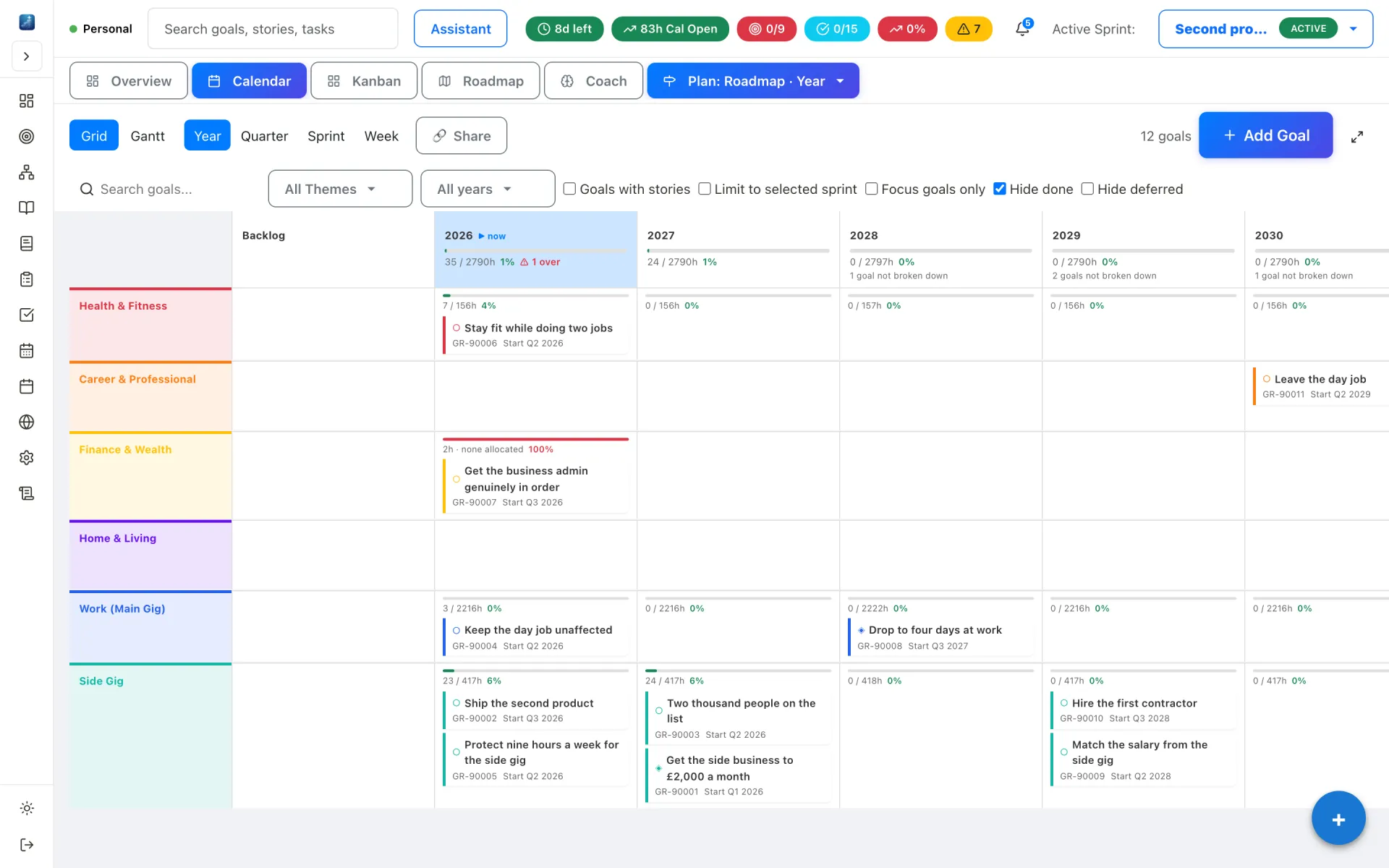
The whole horizon, arranged by what it is for
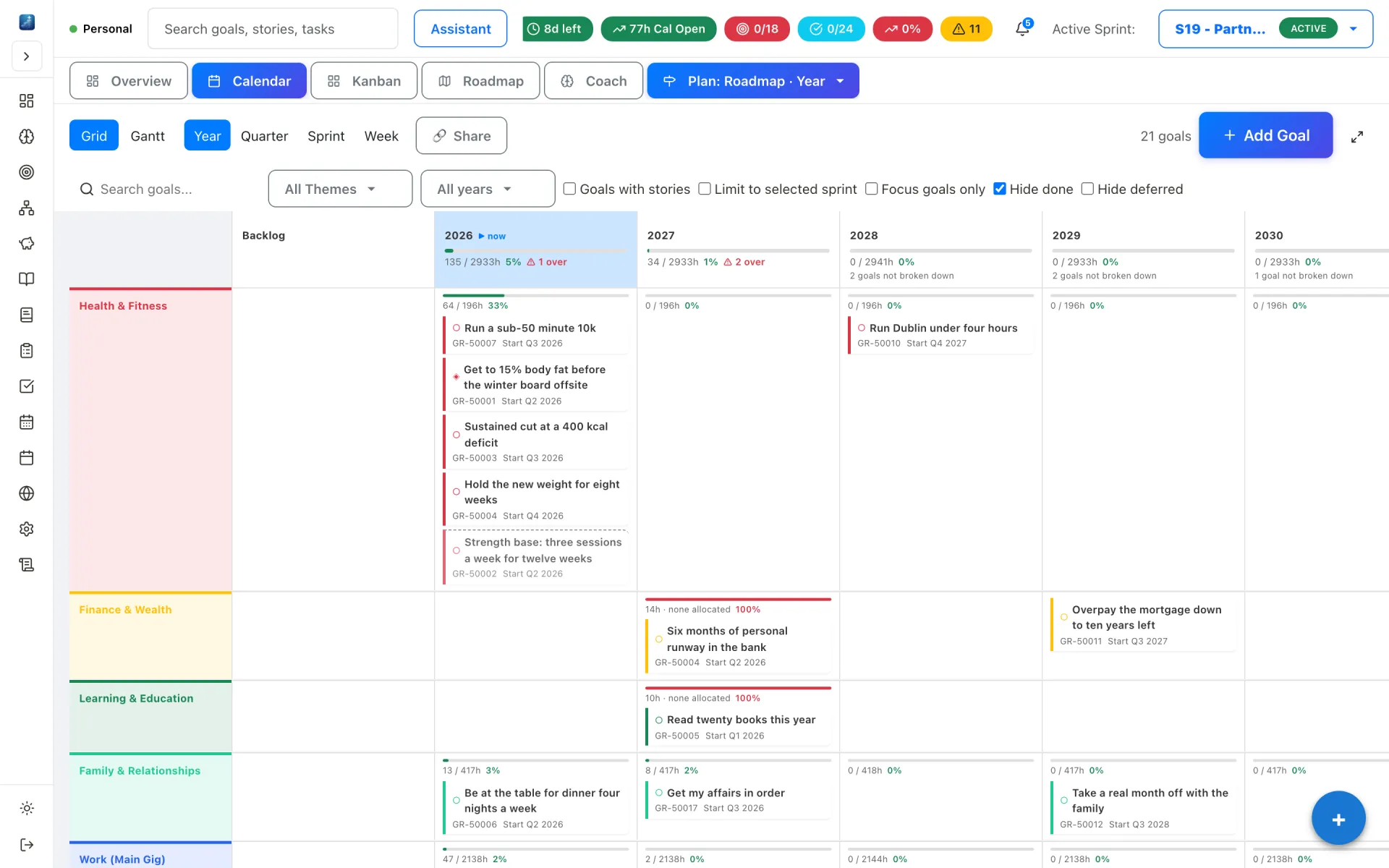
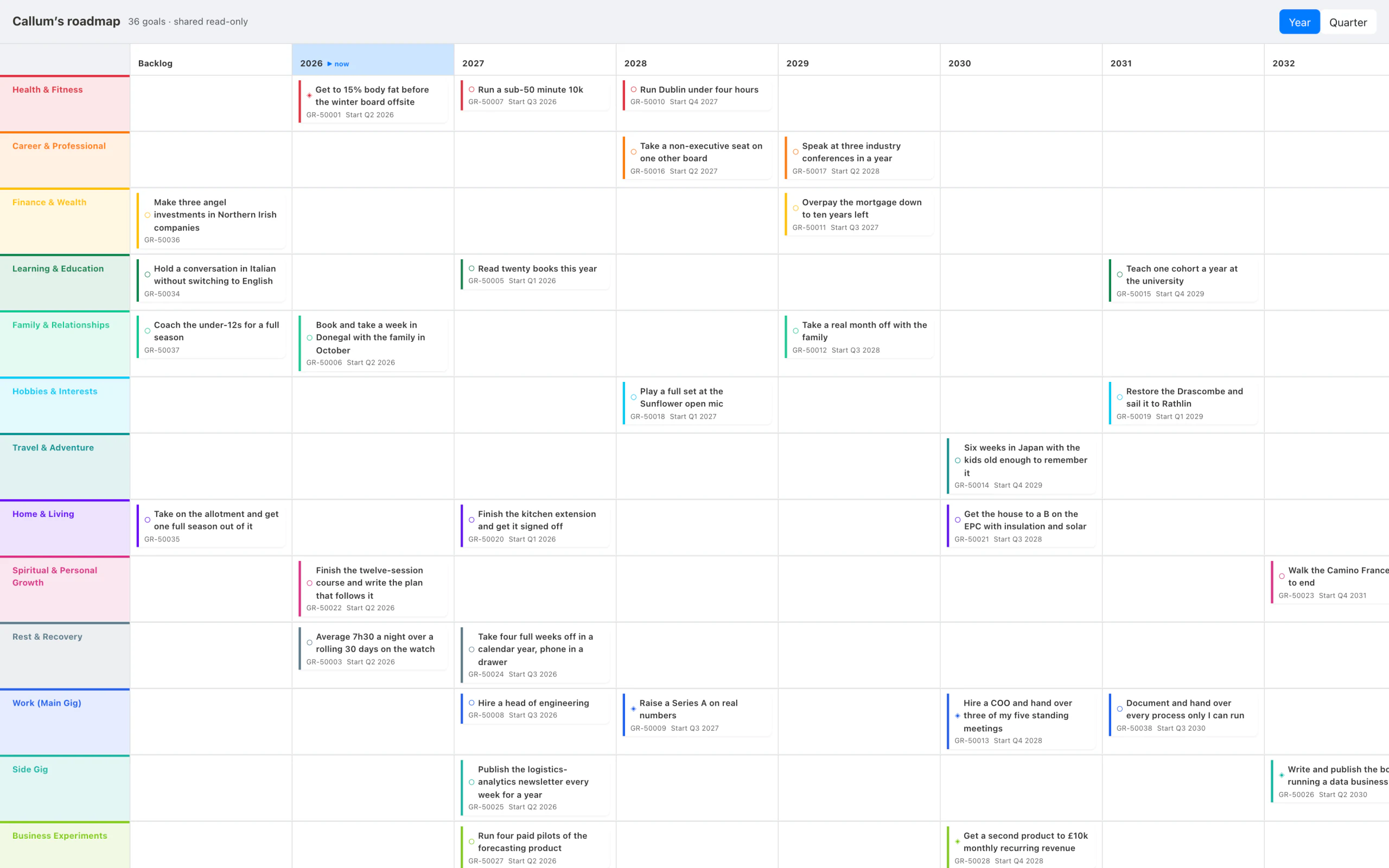
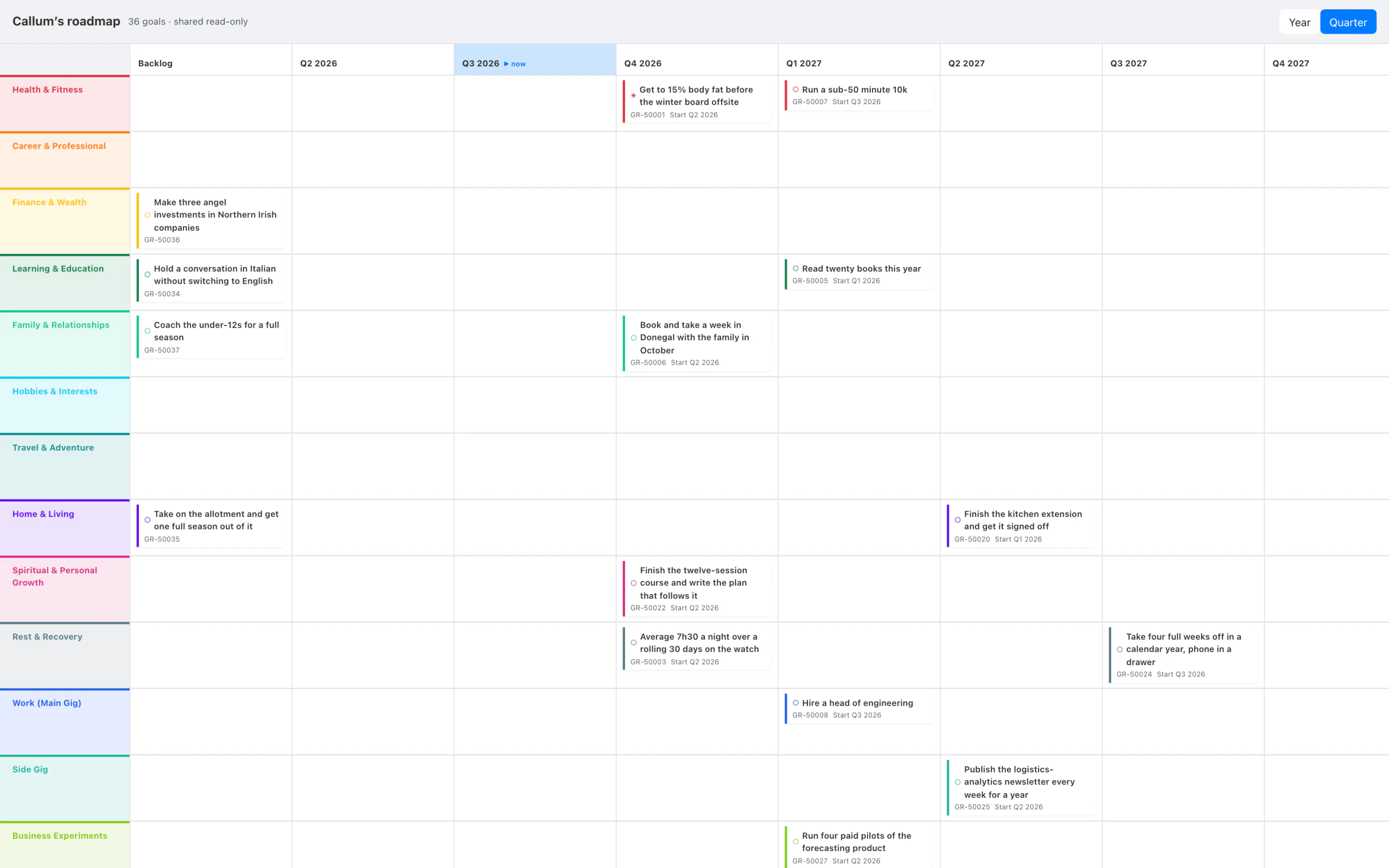
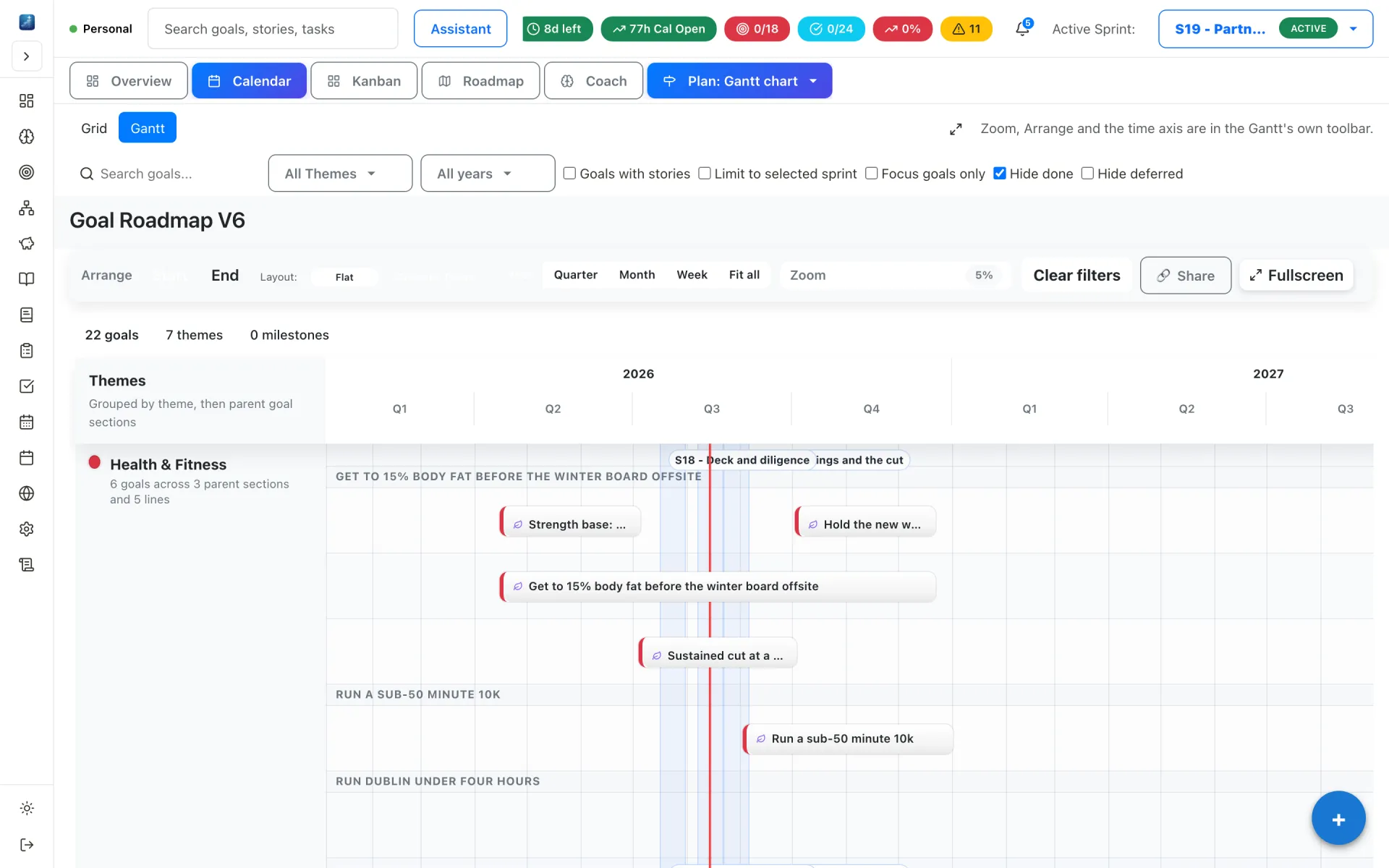
Themes run down the side, time runs across, as far out as you have put anything. Every goal sits in the theme it serves with the hours allocated against it. Drag it to a different year to reschedule. Overcommitment shows as a warning now, not as a surprise in eighteen months.
- Year, quarter, sprint and week views off the same data
- Ask the model to break a goal into stories, then edit what it wrote
- Publish a read-only roadmap to share with anyone
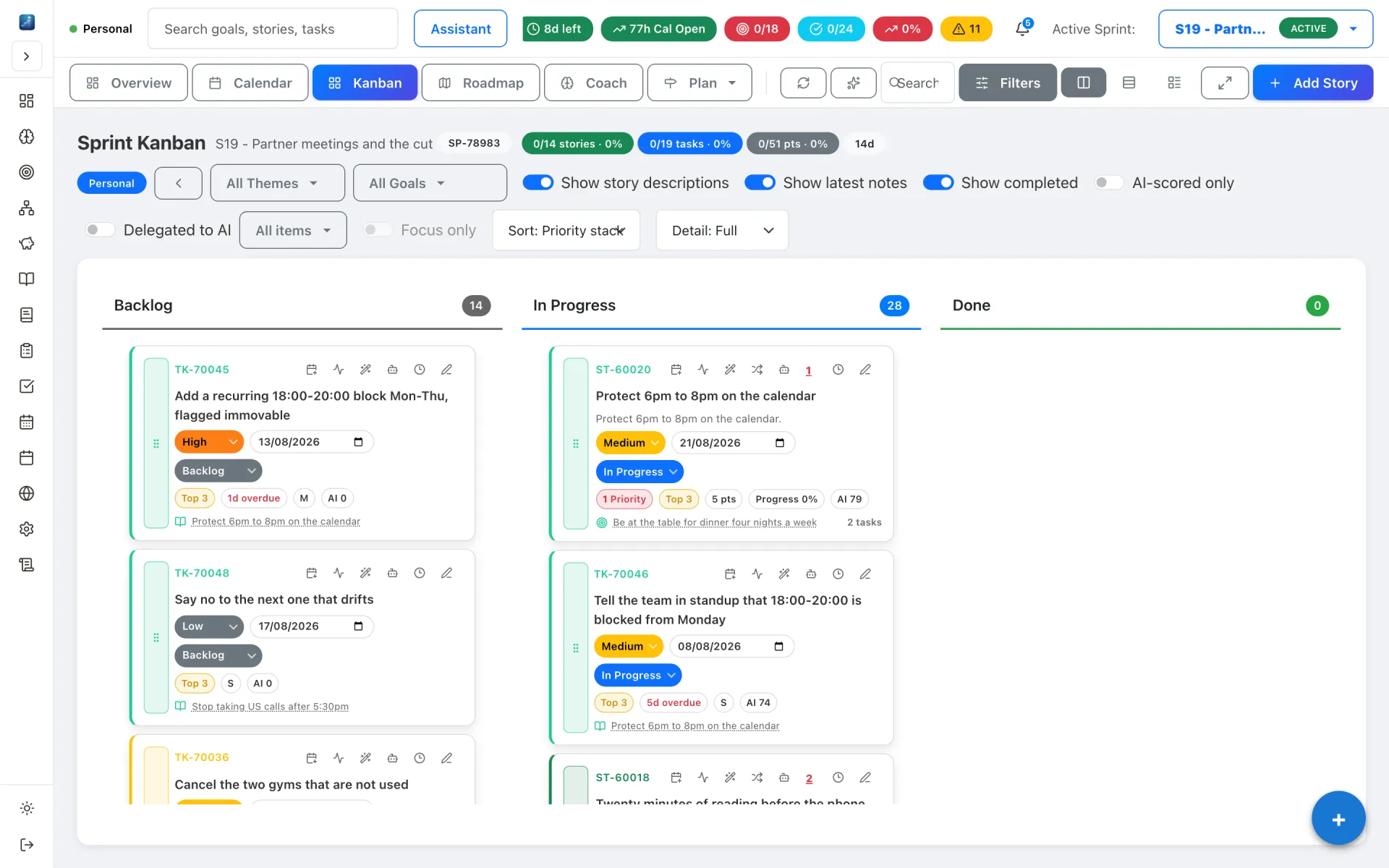
A sprint you can actually finish
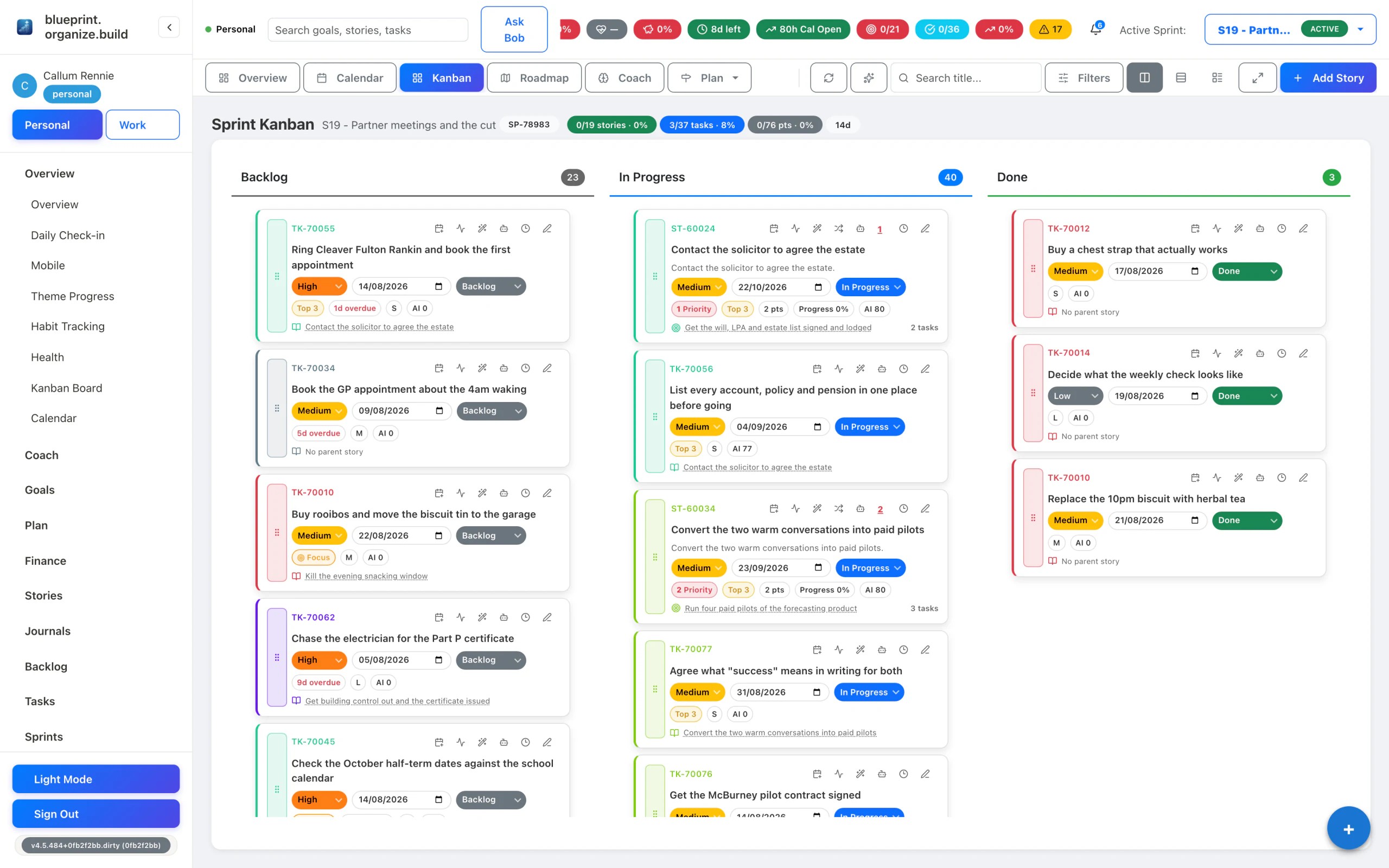
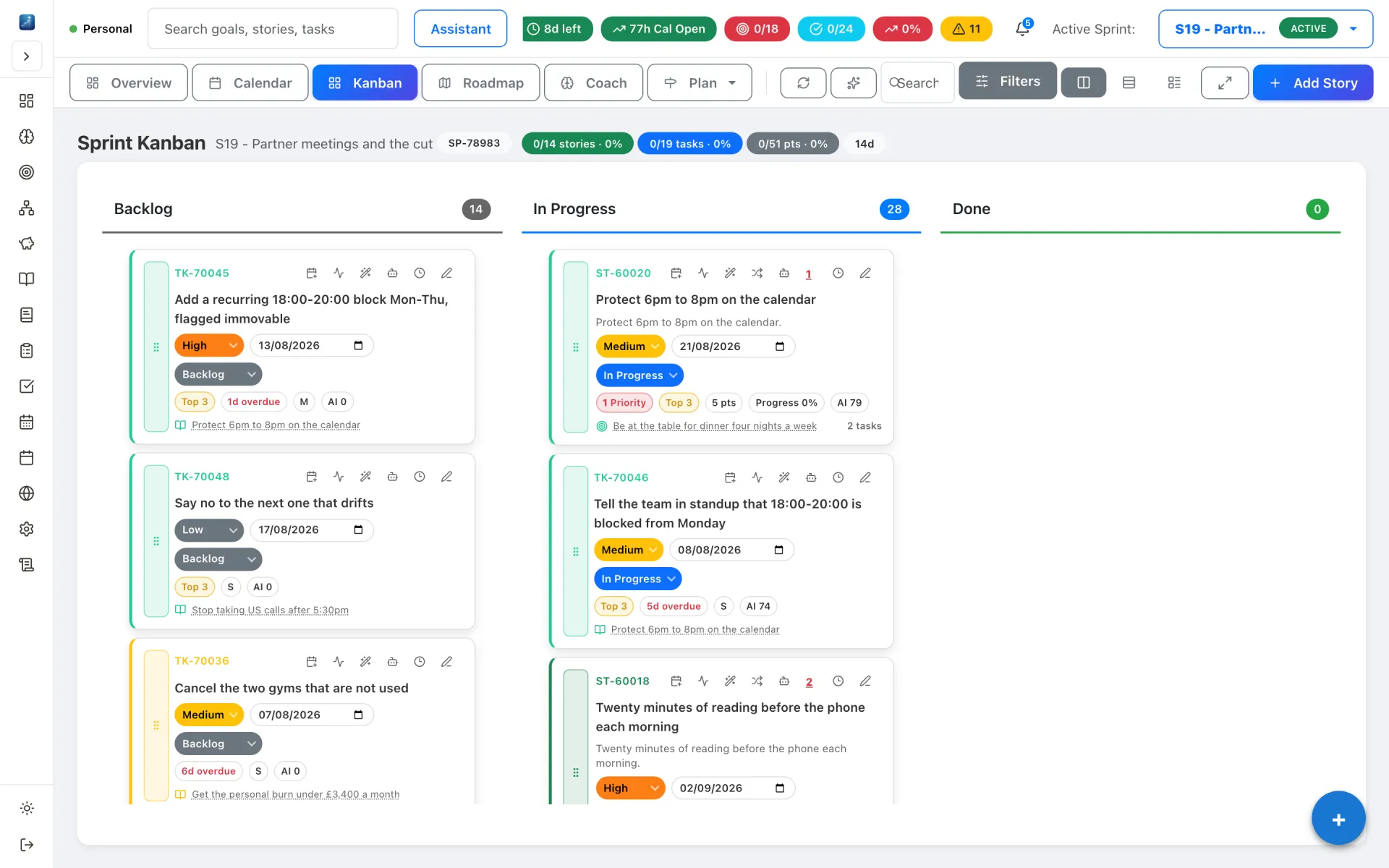
Goals break into stories, stories into tasks, and the sprint holds only what fits. You set the dates, so a sprint is as long as your life needs it to be — we suggest somewhere between two and four weeks. Three lanes, no invented middle states. Each card carries the goal it came from, so nothing drifts loose from the thing it was meant to serve.
- Backlog, In Progress, Done. That is the whole vocabulary
- Points against capacity, so a full sprint looks full
- If a story will not fit inside one, that is the signal to break it down
- The model ranks what is next and says why
Borrowed from agile. Bent to fit a life.
Software teams worked out how to make progress on something big without pretending they could predict it. That part transfers. The stand-ups, the velocity charts and the ceremonies do not, and BOB does not ask you to run them.
The outcome, in your words. Get my affairs in order. Six weeks in Japan while the kids are still young enough. It sits in a theme and has a rough horizon, not a deadline you will lie to yourself about.
A piece of a goal you could finish and feel it. Contact the solicitor to agree the estate. Define the itinerary. If you cannot picture being done, it is still a goal.
Two to four weeks, whichever suits the life you are planning around — you pick the dates. Not a target, a container. It holds what genuinely fits, and if something will not fit inside one, break it down until it does. The value is what you leave out.
The part of your life it serves: health, family, money, learning, the side project. Themes get hours, and hours are finite. That is where honesty enters.
Nothing here needs a perfect setup. Put in one goal and BOB will work with one goal — it meets you where you are rather than demanding you model your whole life before it does anything useful.
Yes — everything has AI in it now. Ours is not the point. A model that writes you a beautiful plan for a week you do not have is just a faster way to feel behind. What matters is what the plan is built against: the holiday already booked, the work gig, the two hours on Thursday that are already someone else's.
One horizon, pulled in until it is the next thing you do
Not five tools bolted together. One set of goals, seen from five distances. Ten years out it is a shape. By Thursday it is a two-hour block that fits between the school run and the work you already committed to.
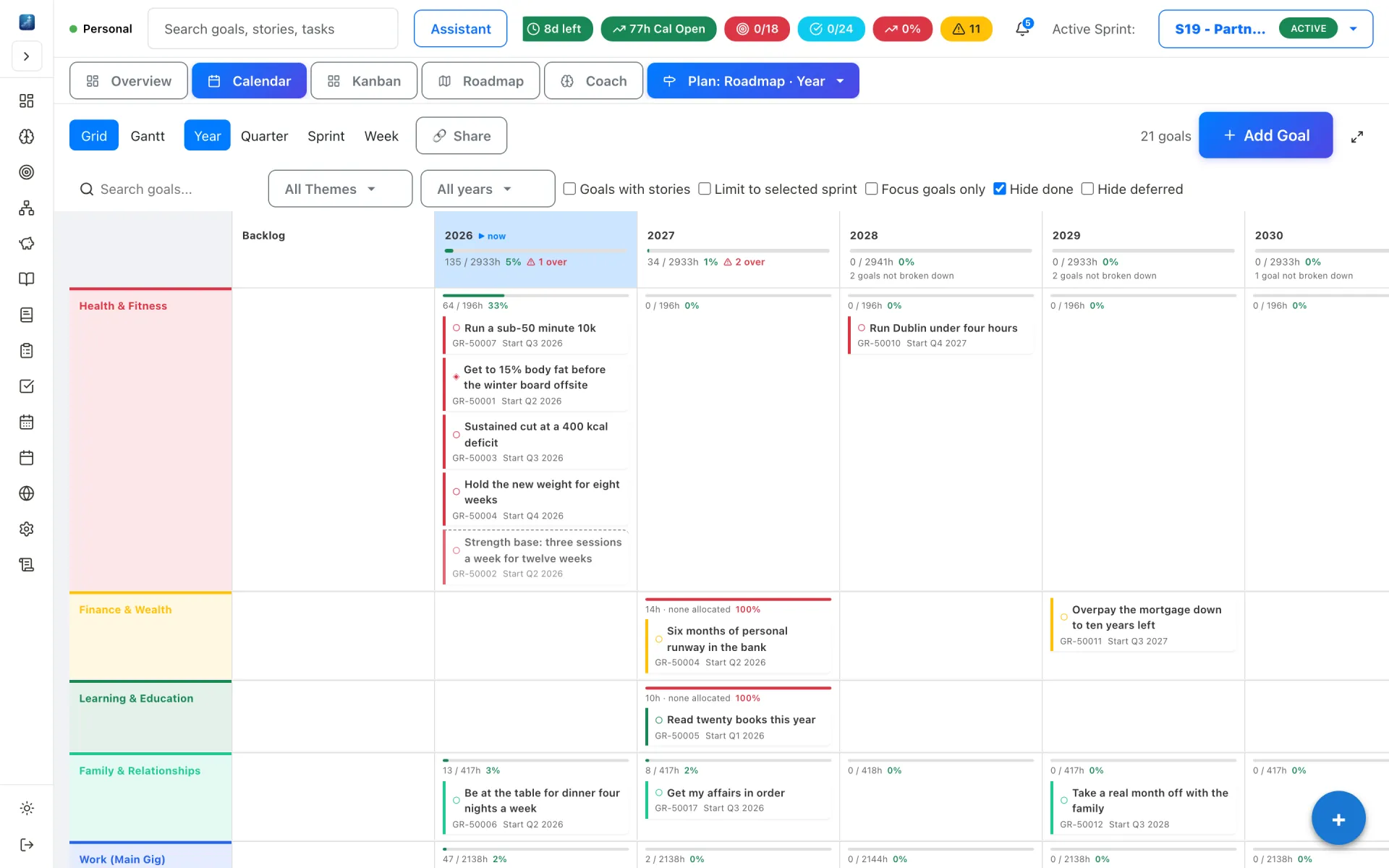
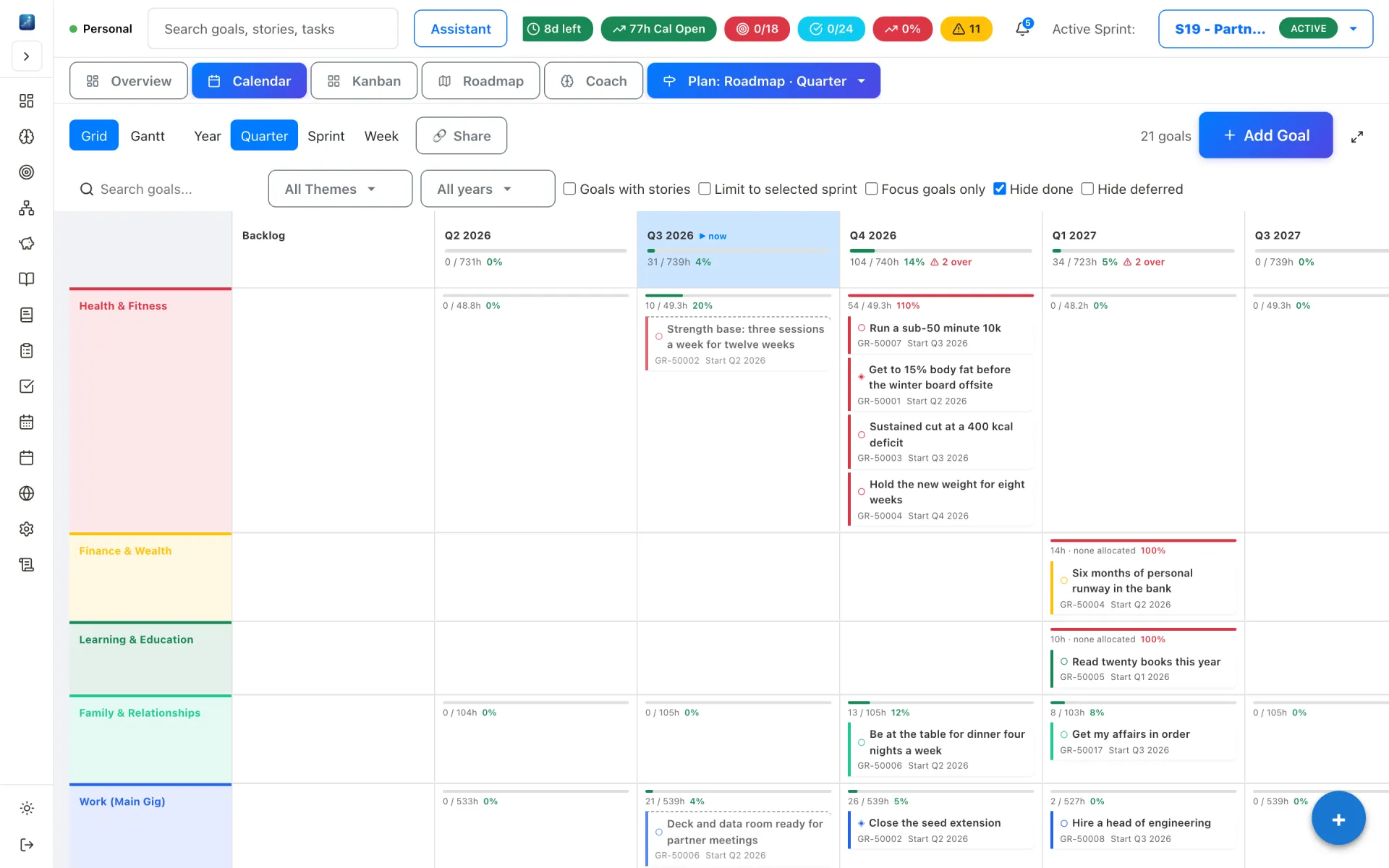
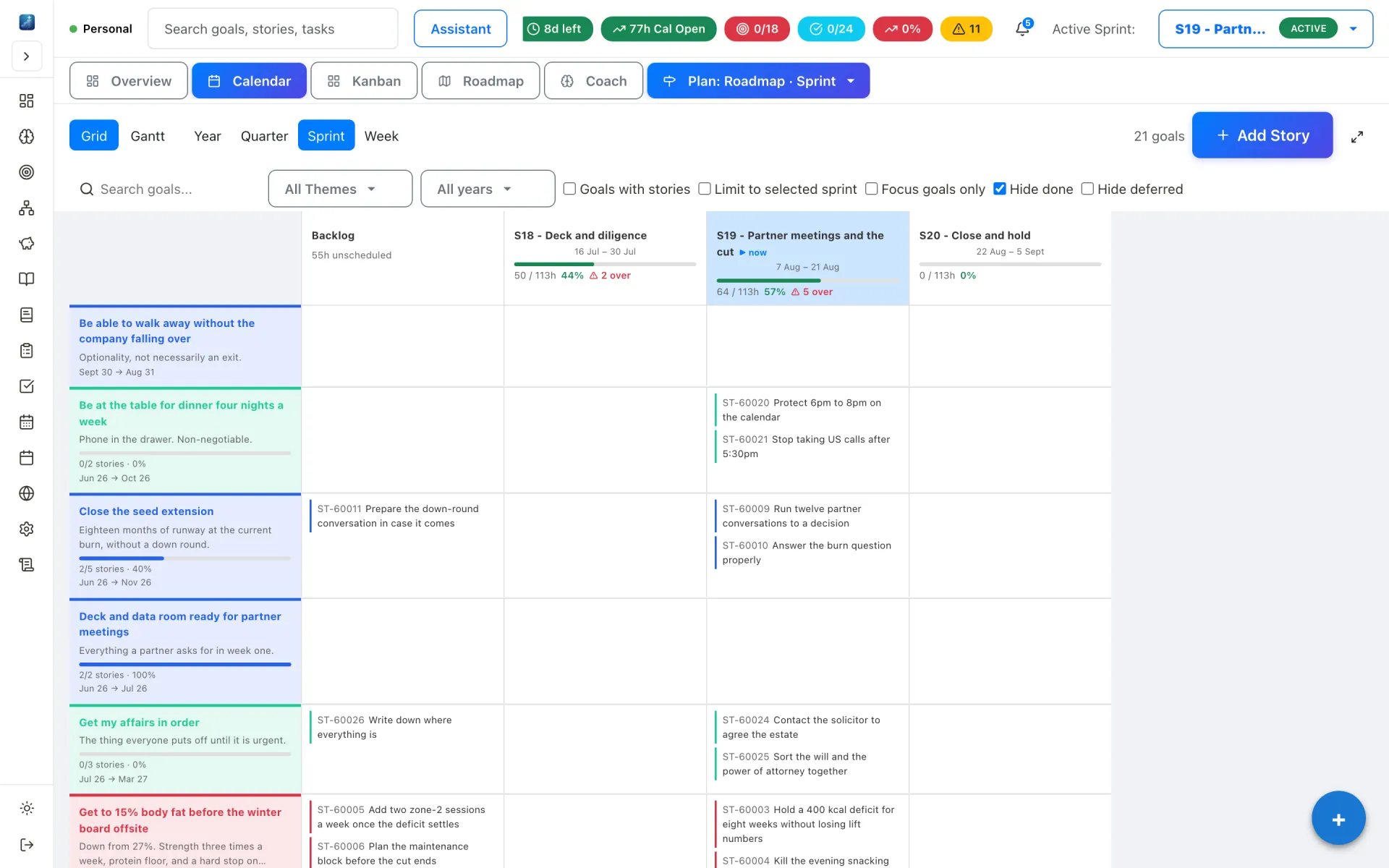
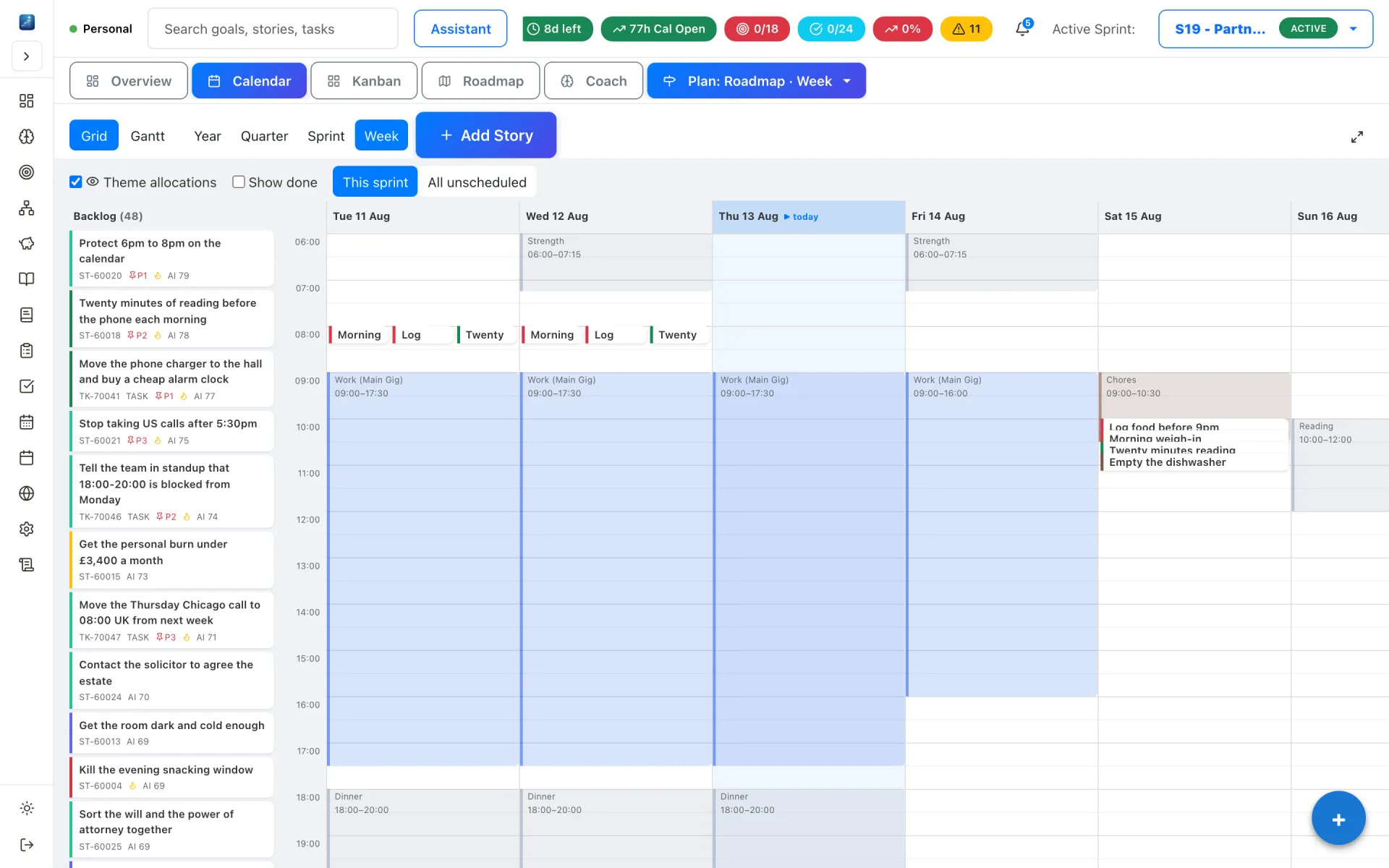
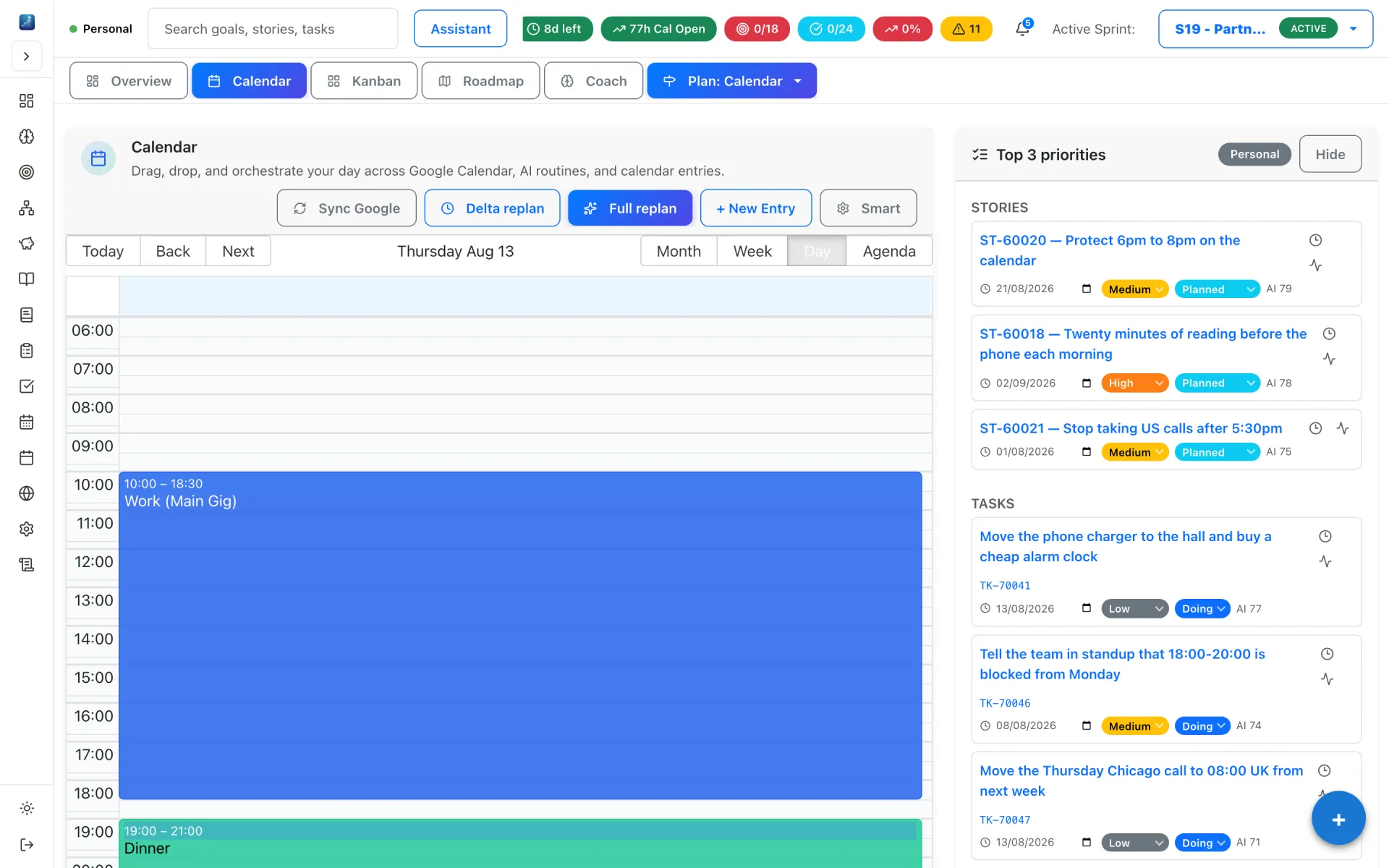
Ten years of themes. Nothing is scheduled yet — this is what the decade is for.
The last step is the only one that matters on a Tuesday
The holiday is on the calendar. So is the work gig, the school run and the two hours you already promised someone else. BOB fits the side project, the training block and the reading around them — and if it will not fit, it says so before you commit, not in the retrospective.
- Your calendar is an input, not a rival. Existing commitments are the constraint the plan is built against.
- A full week looks full. Hours are budgeted per theme against real capacity, so overcommitment shows up as a warning.
- One next action. Not a ranked list of forty things — the single thing that moves a goal you actually chose.
Say it out loud, without saying all of it
A plan nobody else has seen is a plan you can quietly renegotiate. So BOB will publish your roadmap on a link — read-only, no sign-in, nothing to install at the other end. Send it to the friend who asks, the coach you pay, or the group chat that will not let you forget.
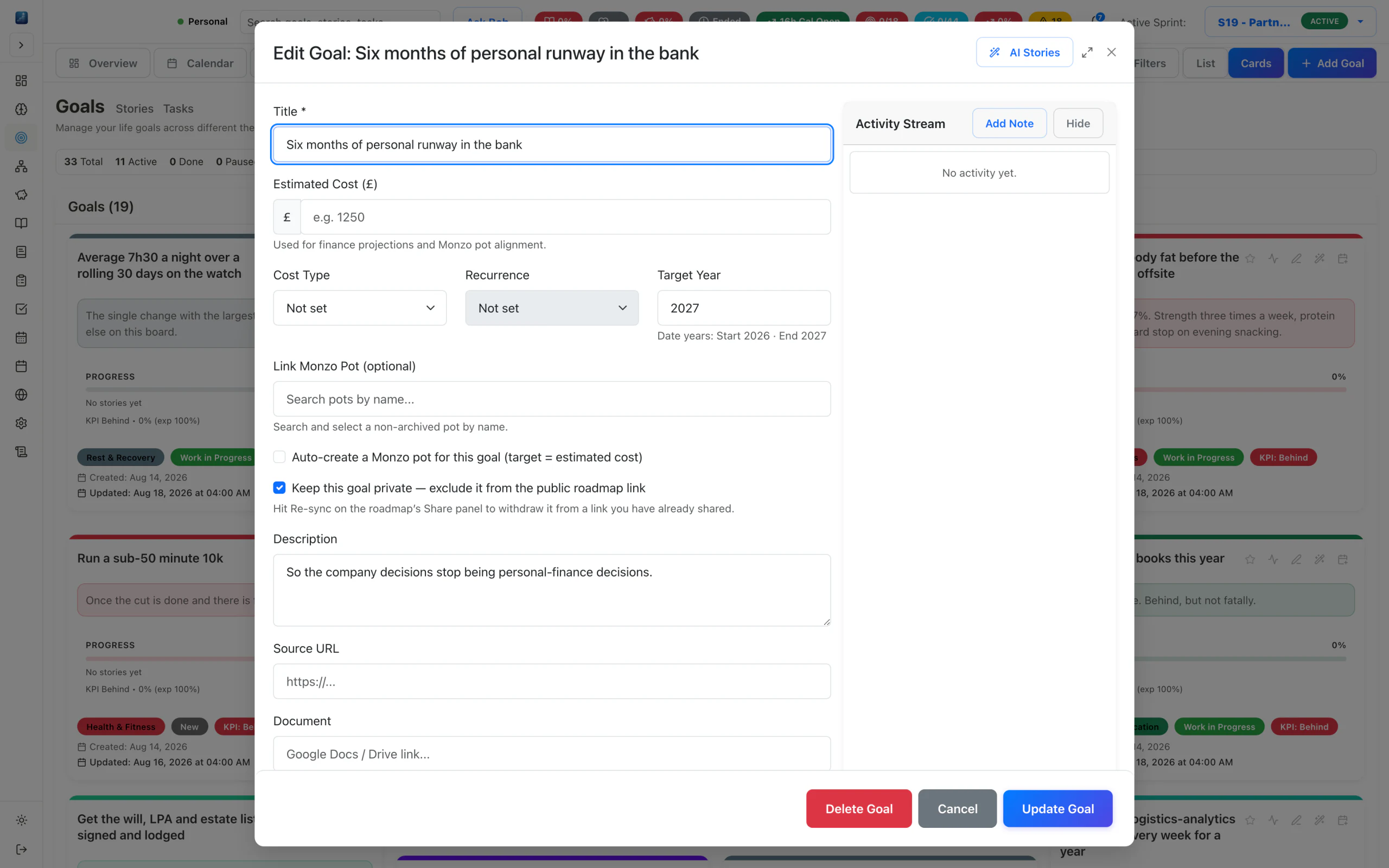
The reason people do not share plans is that a plan holds the money, the job hunt and the things not said yet. So sharing is not all-or-nothing: any goal can be marked private and it never reaches the link, whether you decide that before you share or six weeks after. The rest still goes.
- Read-only and sign-in free — whoever you send it to just opens it
- Mark any goal private and it leaves the link, including one you already sent
- Whoever opens it chooses the distance — the decade, or this quarter
- Revoke it and the link is dead, everywhere, at once
Open an example roadmap Callum is not real. Neither are his goals — this is the same fabricated account as every screenshot on this page.
This is not goal tracking
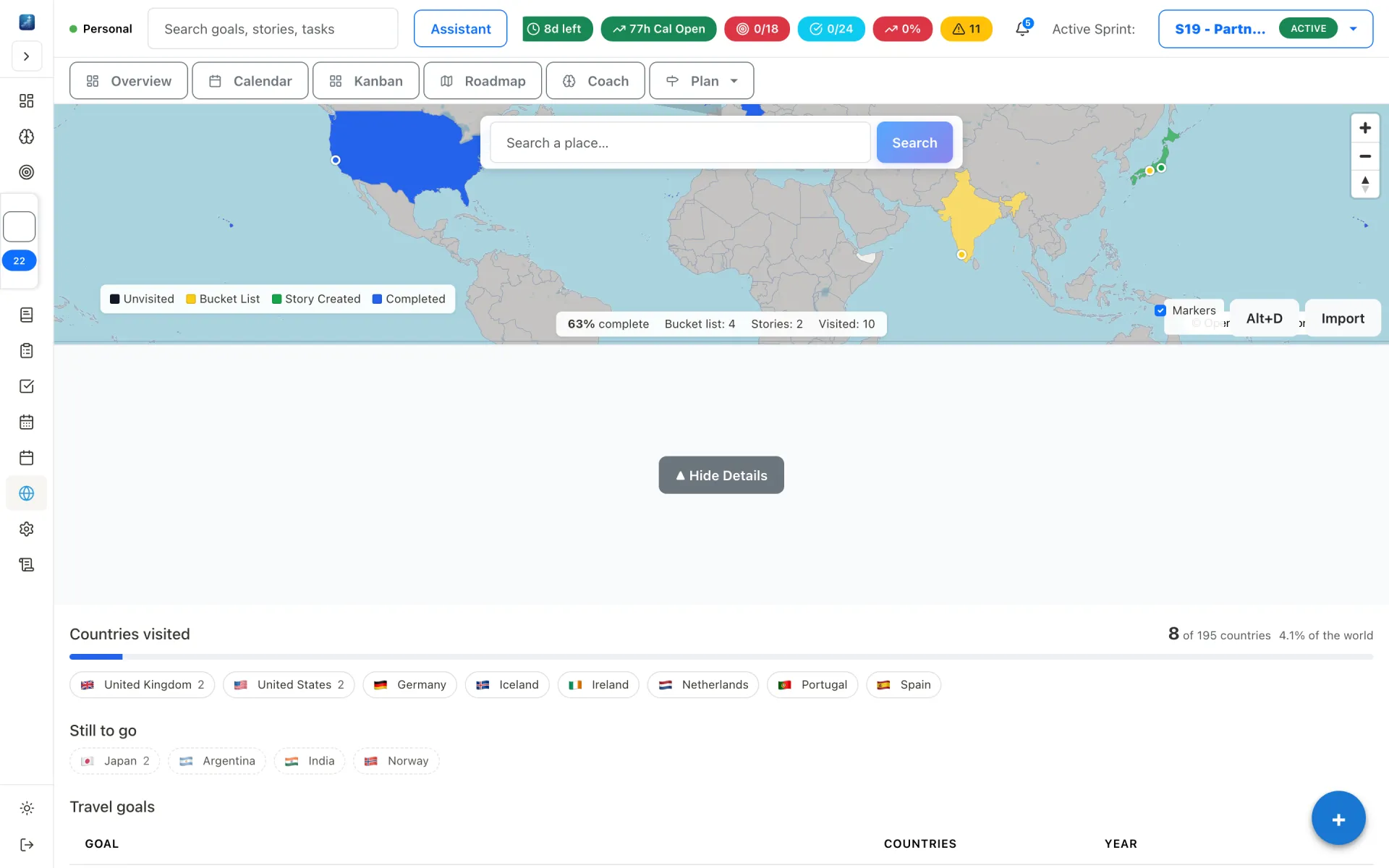
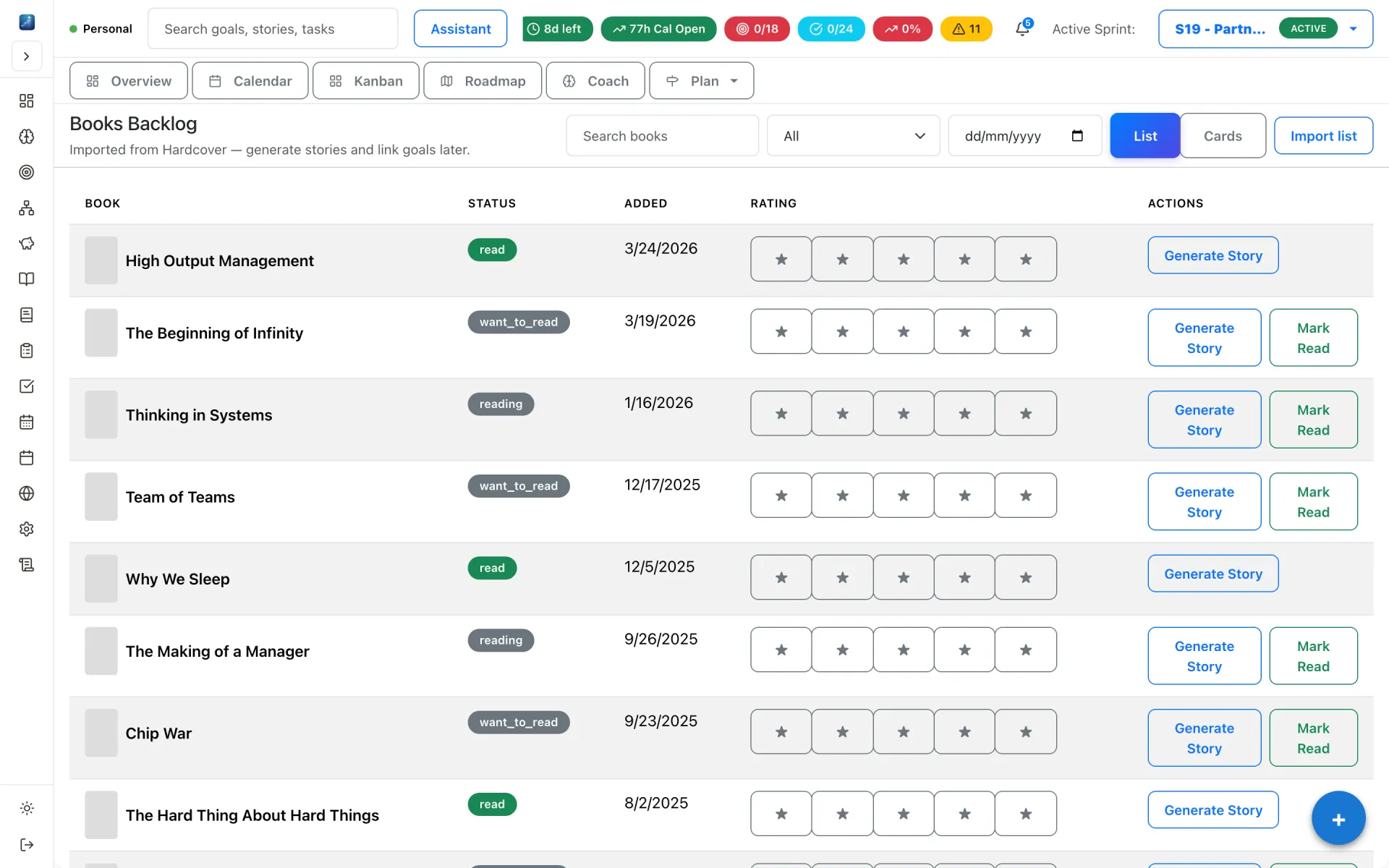
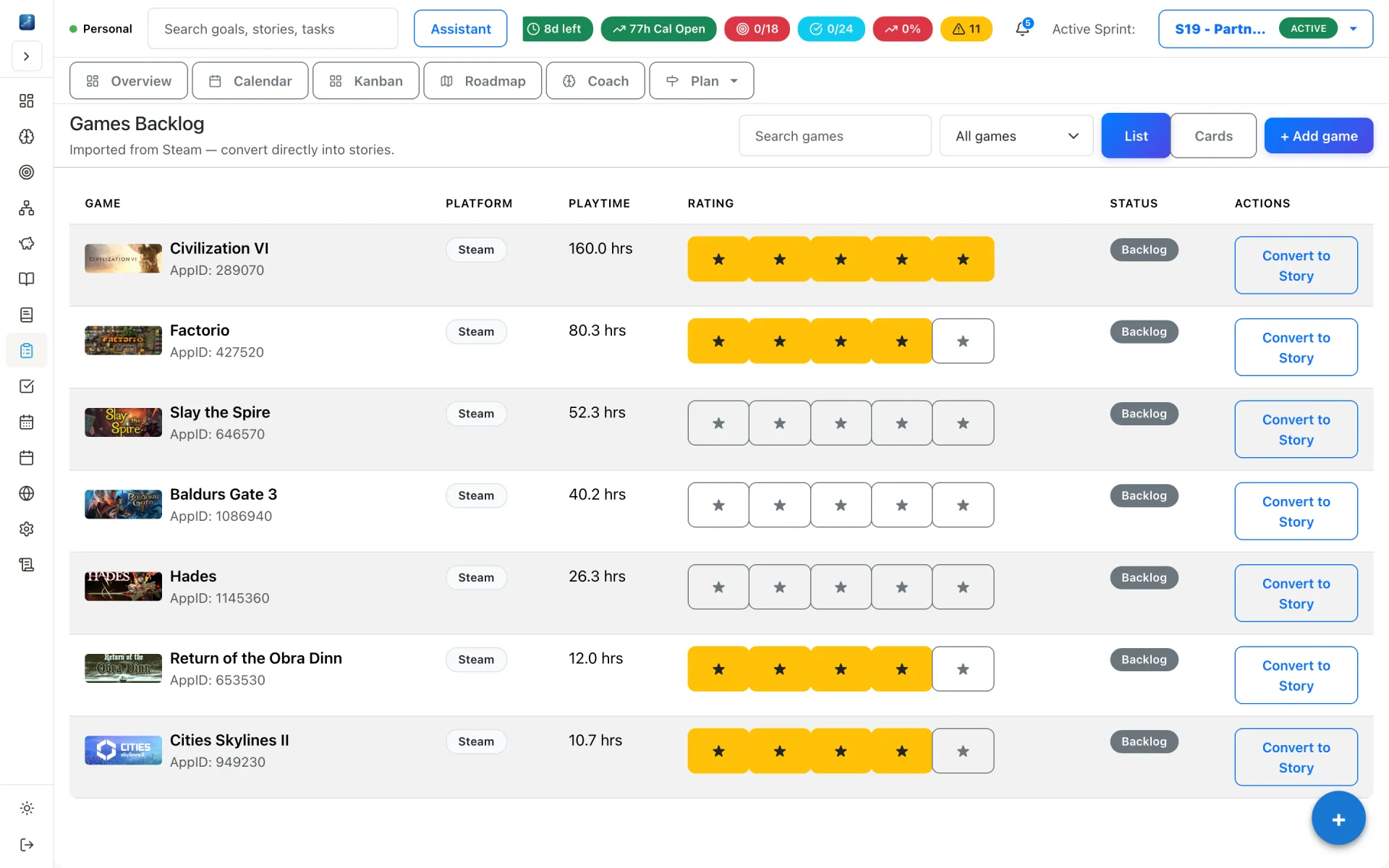
A tool that only holds your ambitions is a tool you avoid opening. The trip you are saving for, the book you are 80 pages into and the game you keep meaning to finish are planned the same way as the side project — because they compete for the same evenings, and pretending otherwise is how the ambitions win every time and you burn out.
Optimise
Narrow it to the few goals that get this quarter, then to the one thing that moves them, and put it in a real hour of a real day.
From a ten-year list to what you are doing at eleven o'clock
Every planning tool can hold a long list of ambitions, and every one of them can hold a list of today's tasks. Almost none of them can tell you how the second came from the first. This is the part BOB is actually for.
Choose the few that get this quarter, and say so out loud
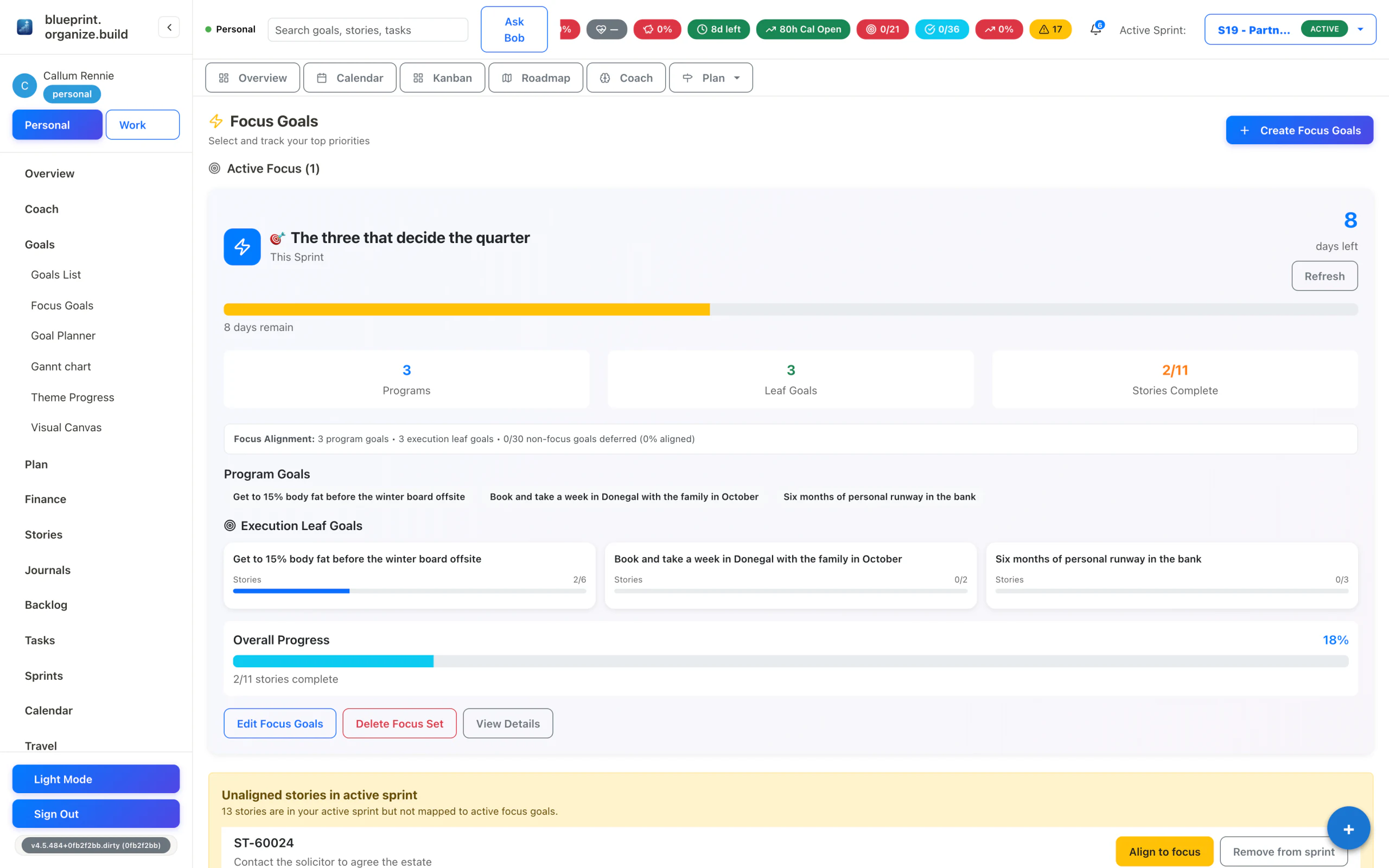
The ten-year view is deliberately crowded — it is everything you have ever said you wanted. Choosing a handful of those as your focus for the quarter is a separate, deliberate act, and BOB treats it as one. Pick them, and it counts what is aligned to them and what is not.
- Days left in the focus period, and stories complete against it
- Anything in the sprint that is not serving a focus goal is named, not hidden
- The rest of the ten-year list stays where it is, waiting its turn
When you cannot see how a goal that size starts, ask
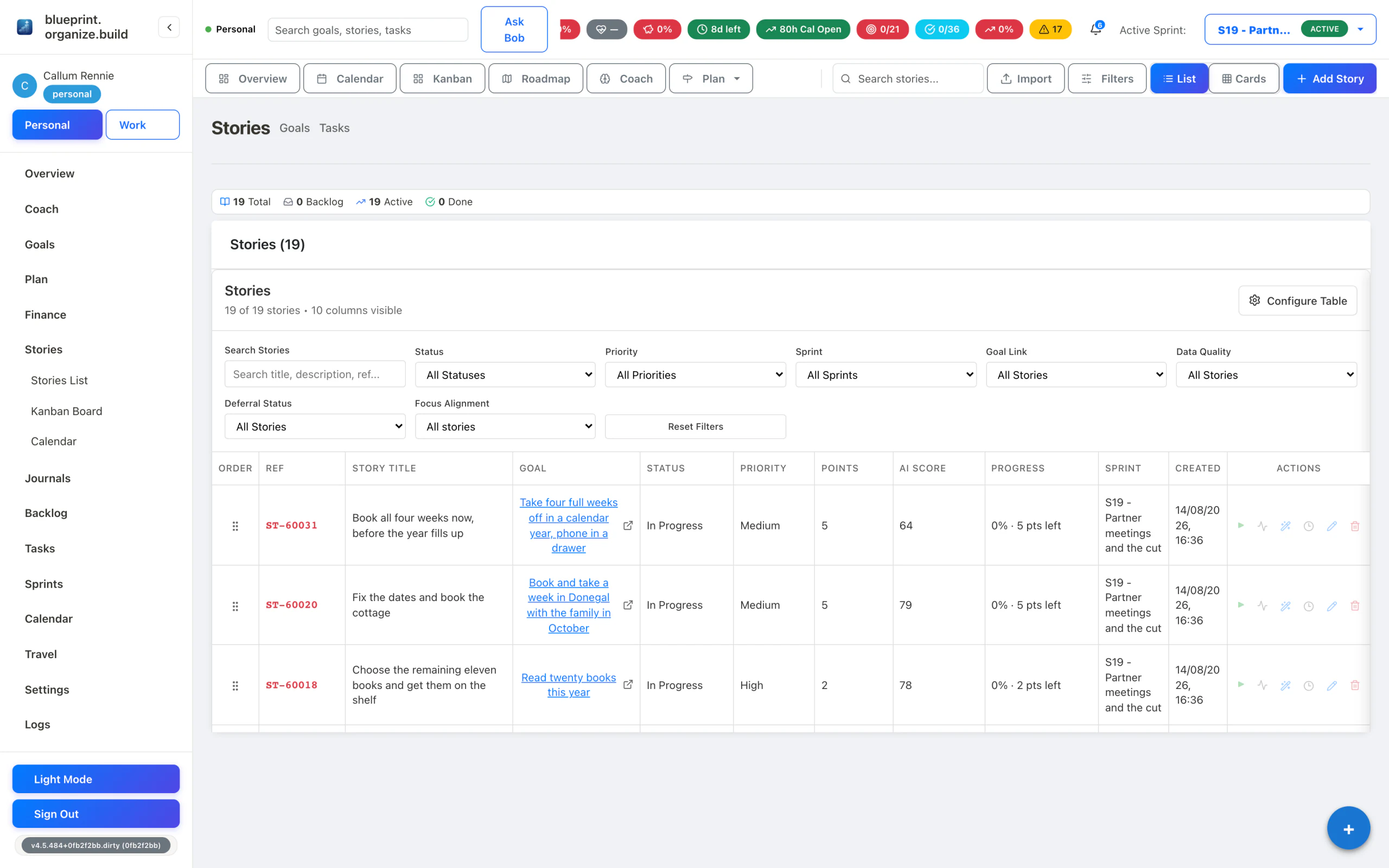
“Six months of runway in the bank” is not a thing you can begin on a Tuesday morning. Getting from a goal to the first honest piece of work is where most plans quietly stop, so BOB will do that step with you — turning a goal into stories, and a story into tasks, using whichever model you have pointed it at.
- Ask it to break a goal into stories, then edit what it wrote
- Every story keeps the goal it came from, so nothing floats loose
- Suggestions, not decisions. It never closes anything on your behalf
You should not have to work out what matters before your first coffee
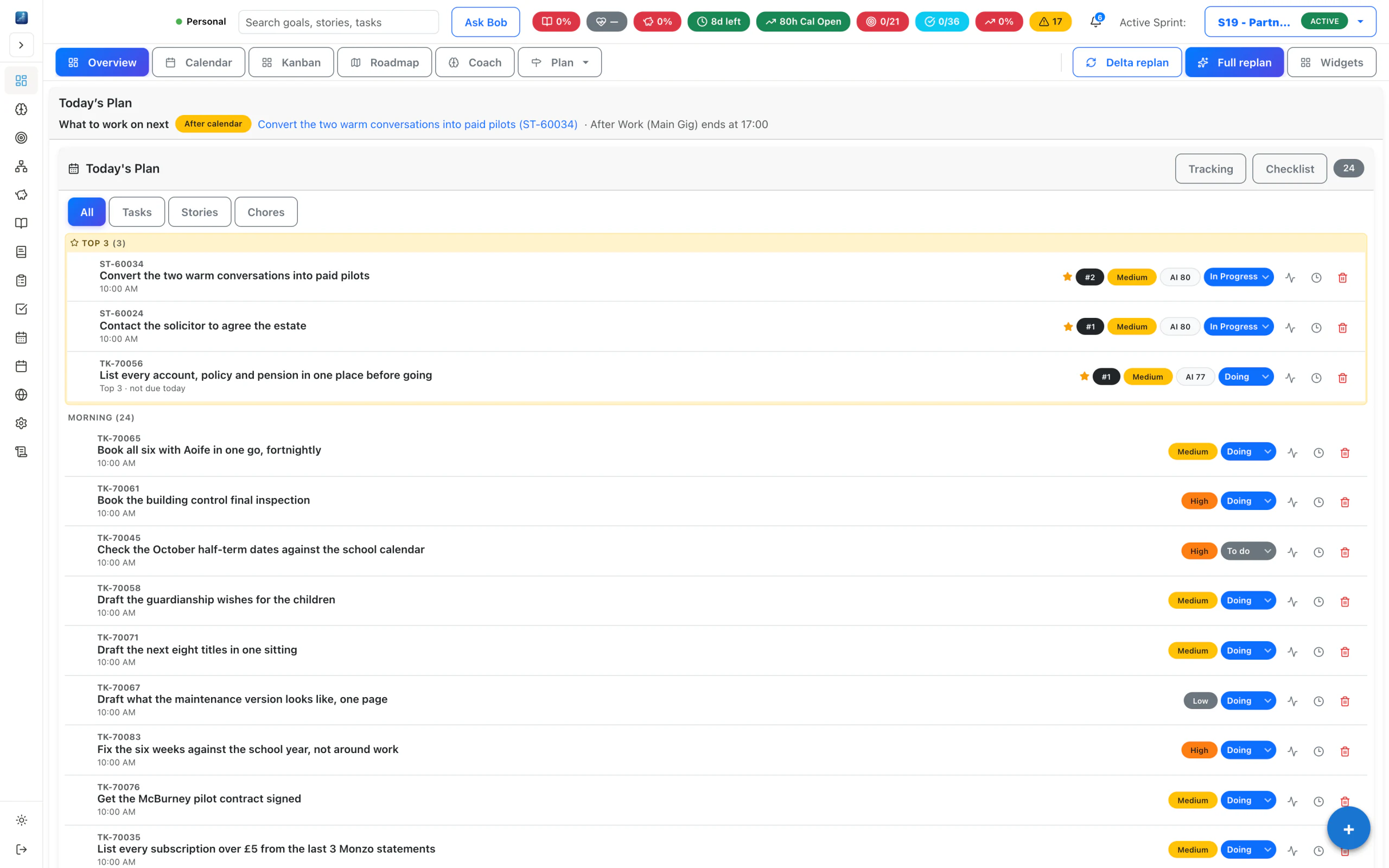
Every story and task carries a score. Some of it comes from you — the goal it serves, the priority you set, the date you gave it. Some of it BOB works out on its own, and the largest part of that is simply age: work that has sat untouched for weeks starts to weigh more, because the things that quietly rot are almost always the things you meant to do.
The three that come out on top become your Top 3 for that day. One short list, already decided, waiting for you.
- Rescored overnight, so the board has re-ranked itself before you open it
- Anything left sitting climbs, rather than sinking quietly down the list
- Pin something by hand and it goes straight to the top. You always win
A priority with no time against it is just a wish
Connect Google Calendar and BOB reads what is already there — the meetings, the school run, the things you did not plan — then puts the day's Top 3 into the gaps that are actually left. The blocks are real Google Calendar events, so they are on your phone, your watch and in front of anyone who shares your calendar.
- Two-way sync: your existing events are read, BOB's blocks are written back
- Move a block in Google and BOB keeps up. Delete it and it goes
- Replan the day when it falls apart, which it will
Your model. Your key. Your prompts.
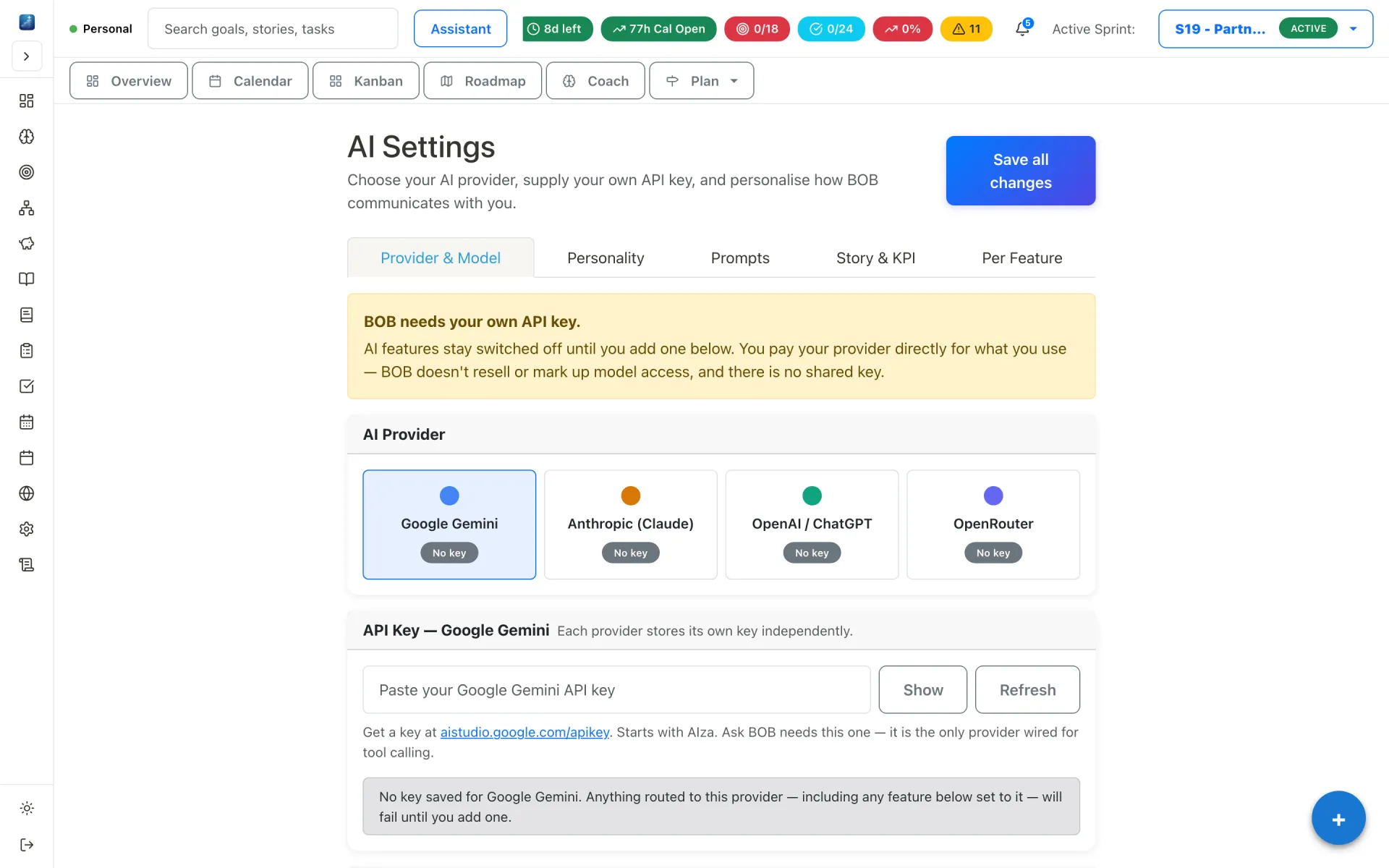
The planning, the ranking and the goal breakdown all run through a language model. Which one is your call, and you bring the key, so the cost and the data path stay yours.
- Pick a provider and a model, then test the connection before you commit
- Bring your own API key, or use ours on the founder tier
- Add your own system prompt and it rides along on every call
- The model list refreshes daily, so new releases show up on their own
Build
Do the work, keep the small things going, and see honestly what landed against what you said you would do.
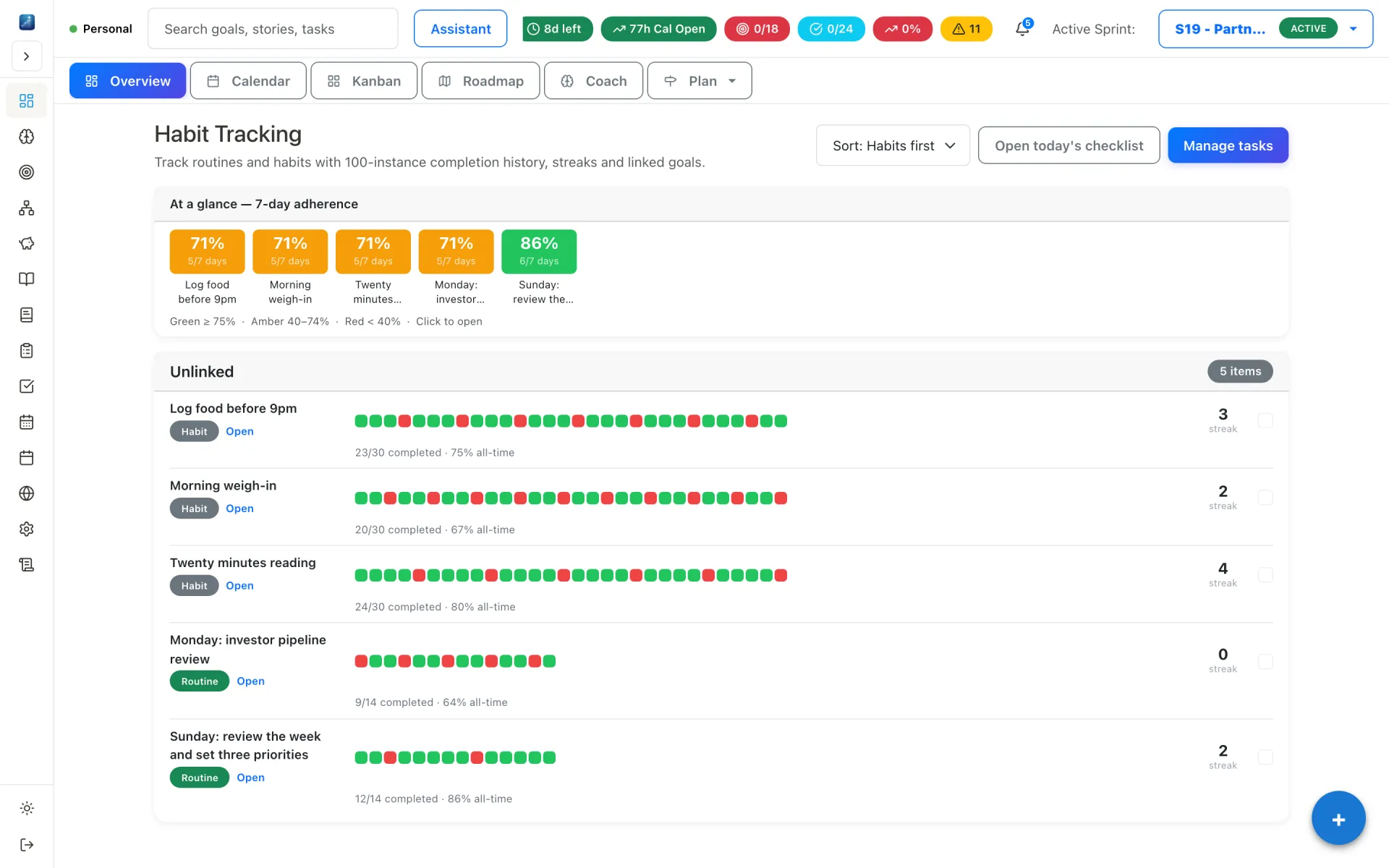
The things too small for a sprint, tracked where they belong
Some things are not projects. Logging food before nine, the Sunday review, twenty minutes of reading. They never finish, so a task list is the wrong shape for them — they need a streak and an honest adherence figure instead.
- Habits and weekly routines, each with a hundred-instance history
- Seven-day adherence in green, amber and red, so a slip is visible early
- Link a habit to the goal it serves, or leave it standing alone
Two numbers: this sprint, and everything you have ever run
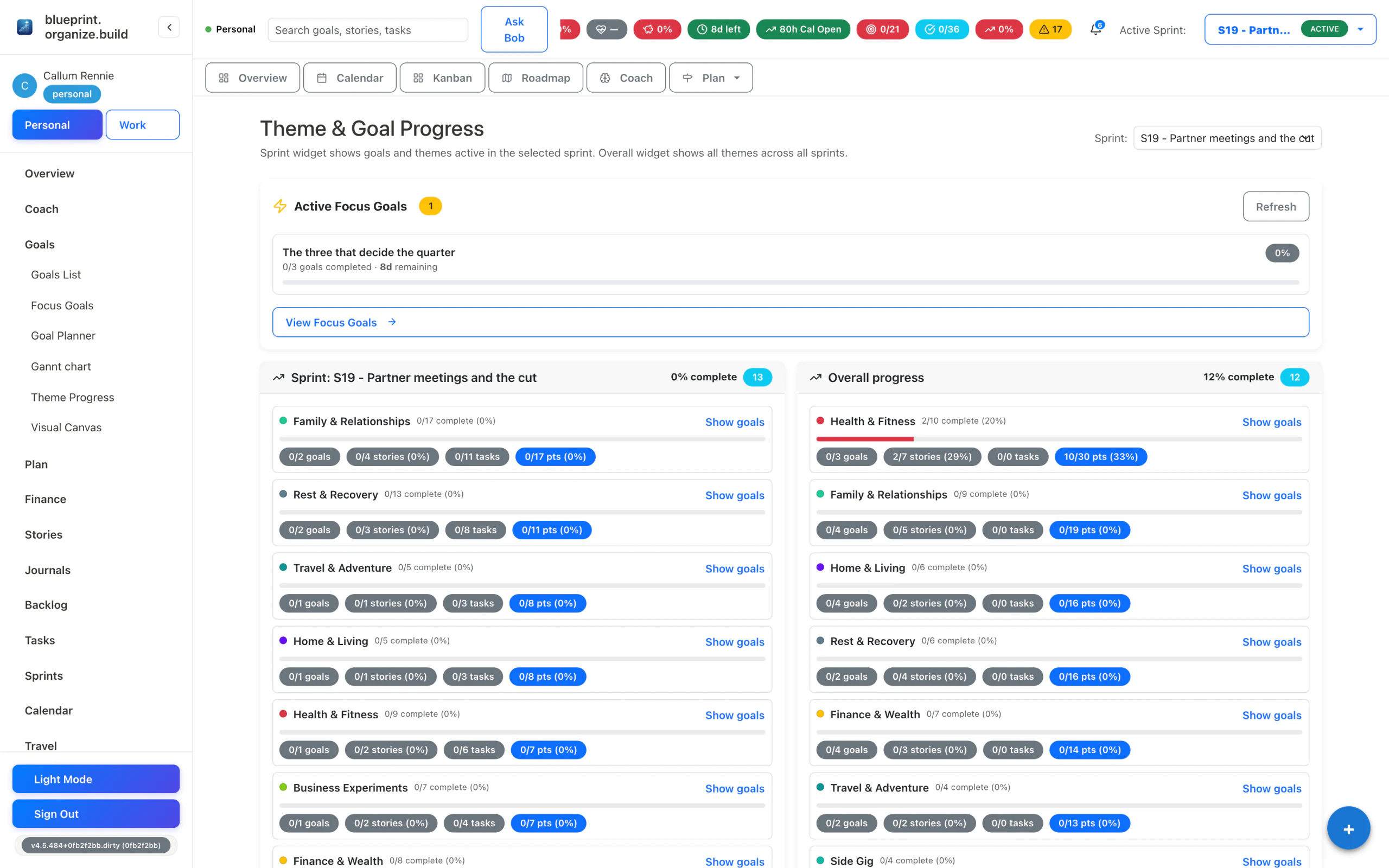
The same work, counted twice. On the left, only what is in the current sprint. On the right, every theme across every sprint you have ever had — not this year, all of it — which is the one that tells you whether a whole part of your life has been quietly starved.
Neither number counts goals. A theme moves on the size of the work underneath it, measured in the points on the stories, so finishing one large piece counts for more than closing three small ones. Ticking off five easy goals will not make a starved theme look healthy.
- Weighted by the work sitting under a theme, not by how many goals you wrote
- Sprint against overall, side by side, so a good sprint cannot hide a starved theme
- Open any theme to the goals, stories and points underneath it
The rest of the picture
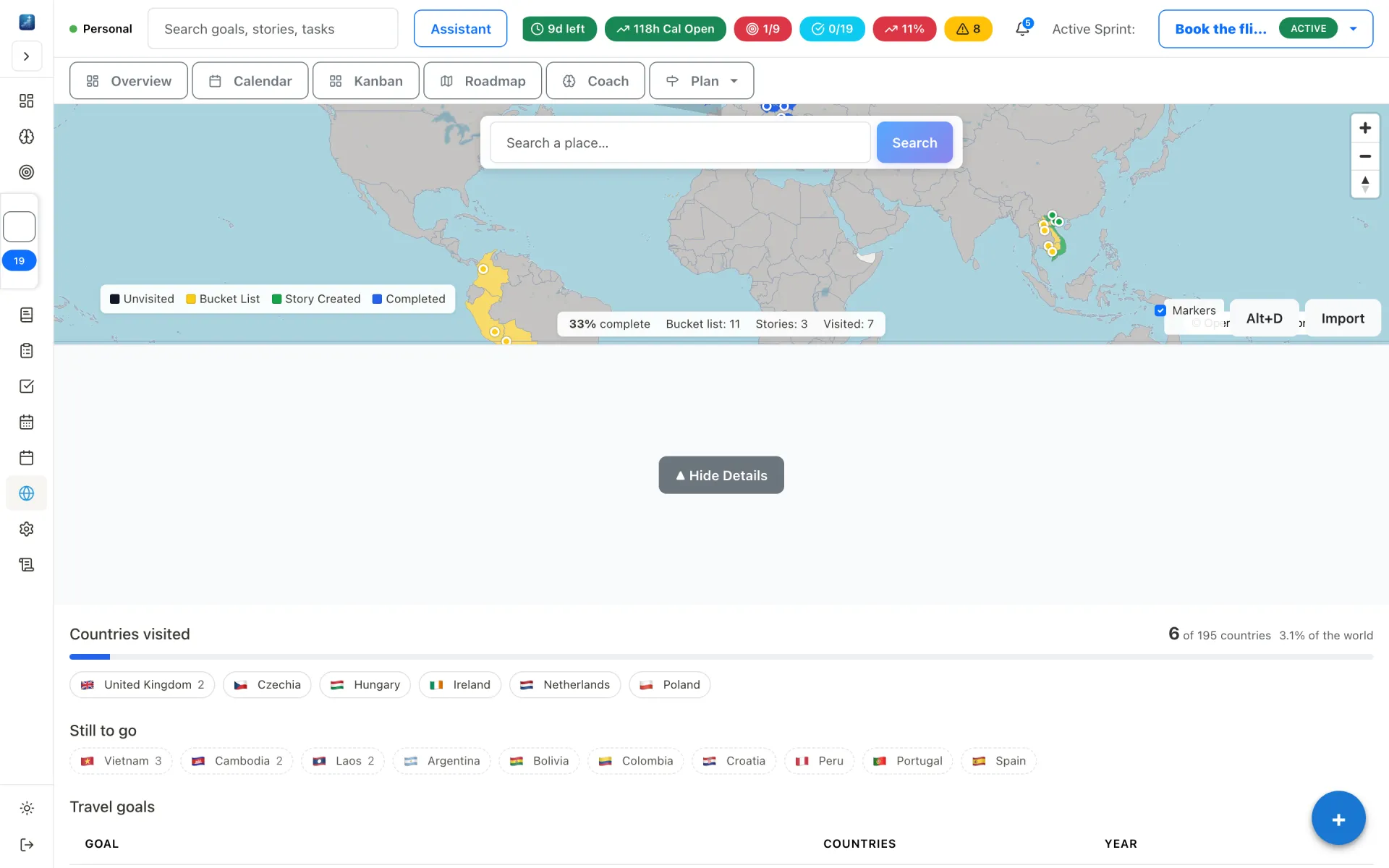
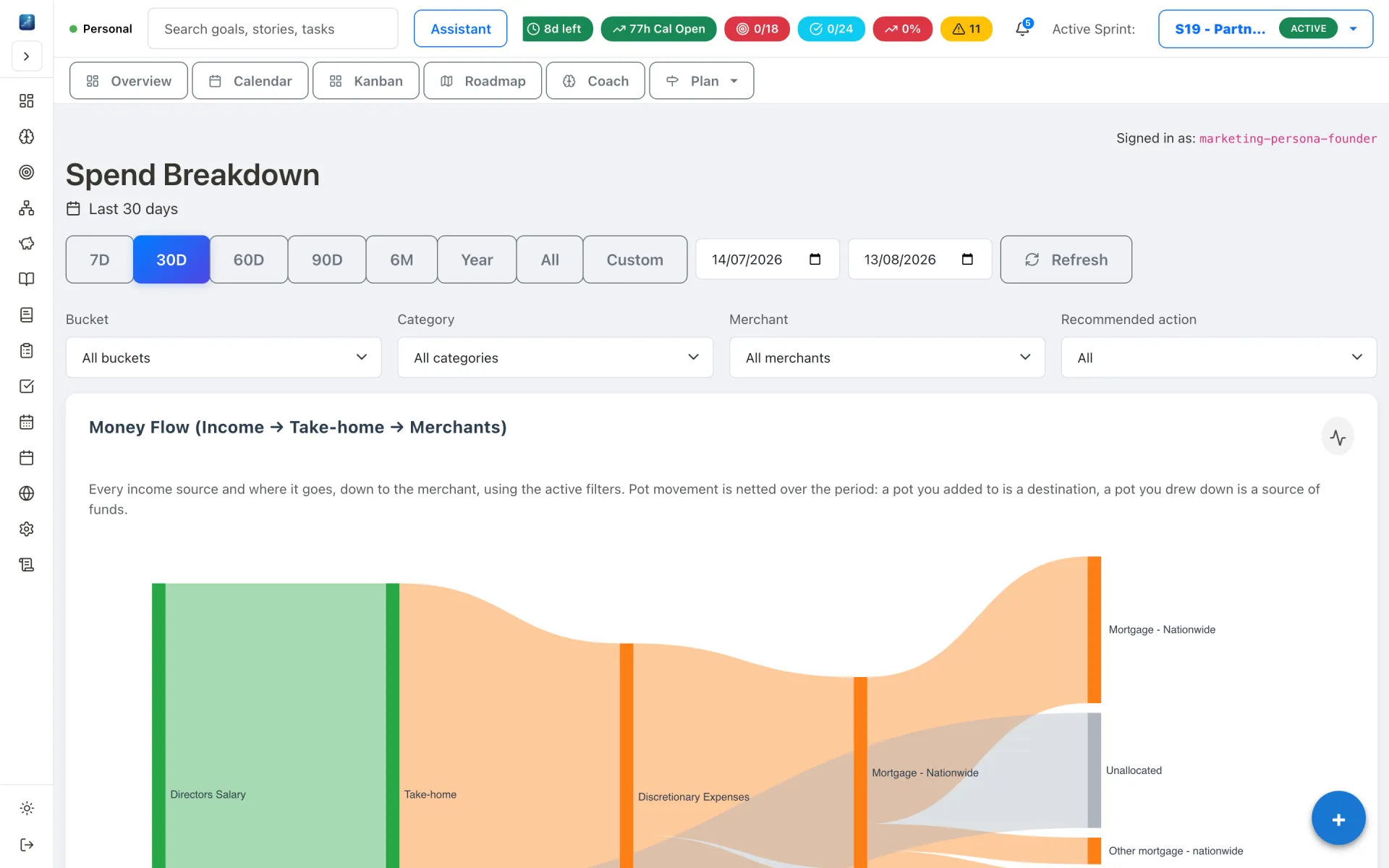
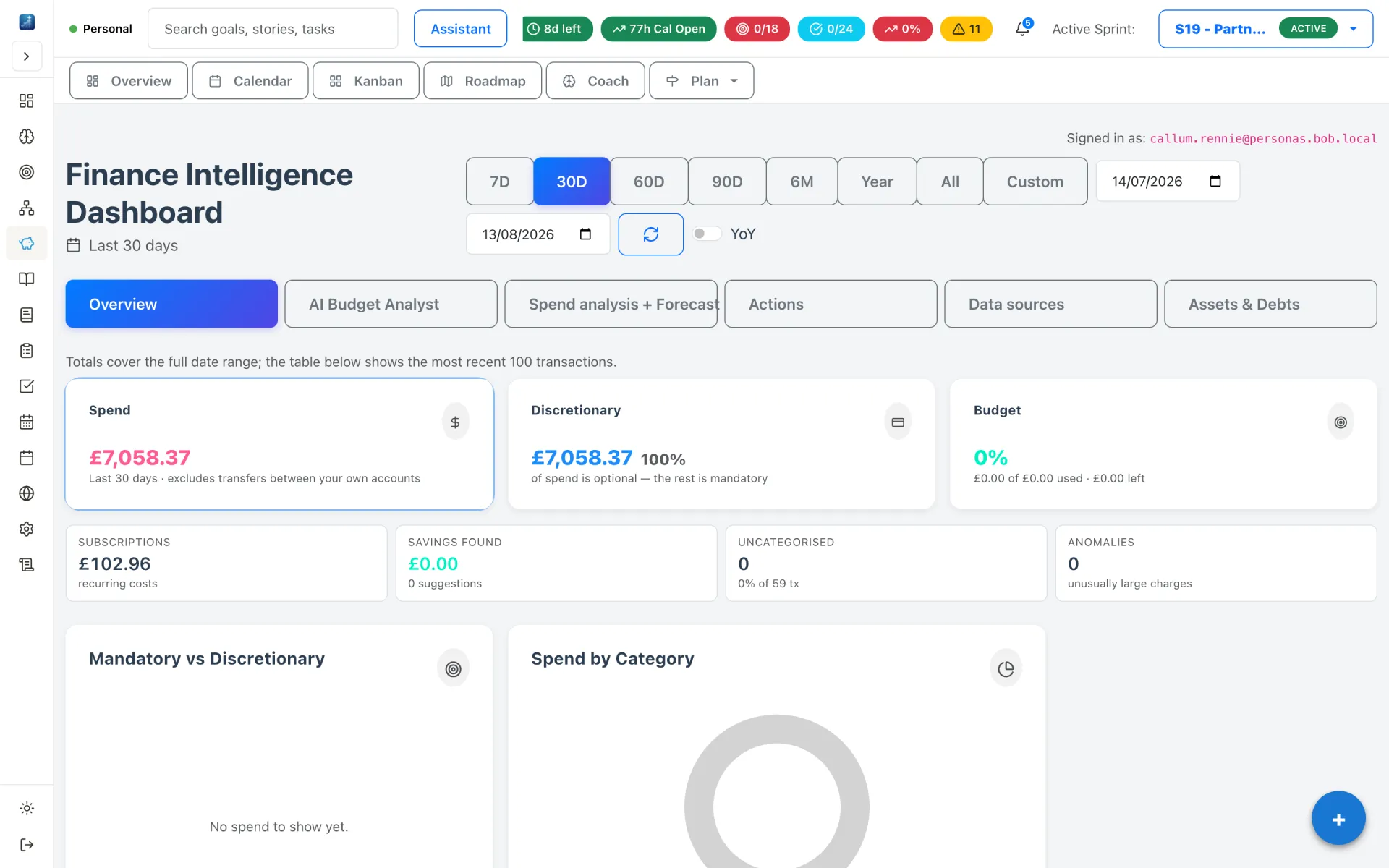
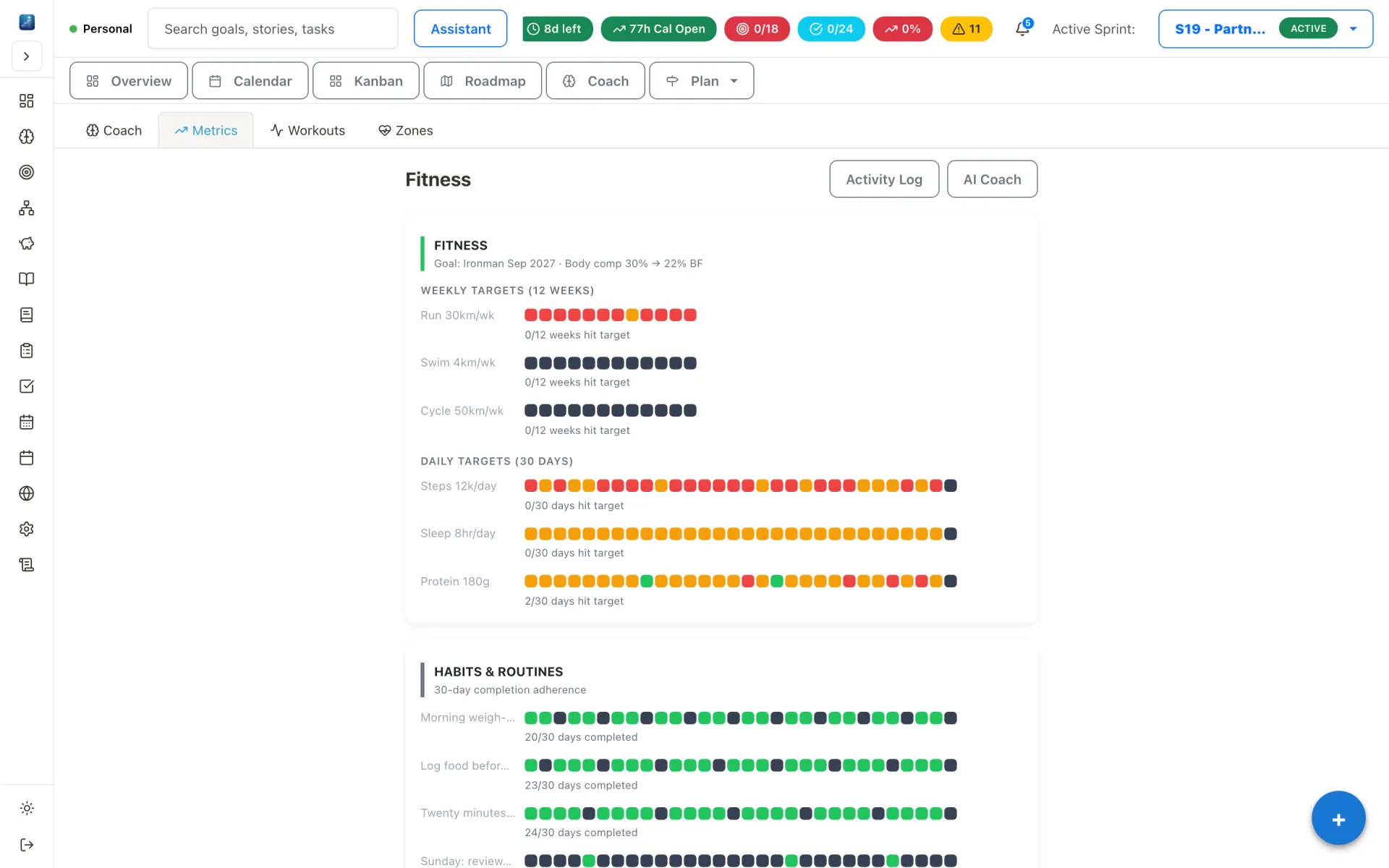
The same goal tree drives the map, the calendar, the money view and the health numbers. Scroll sideways.
Different lives, same thread
Three people who think years ahead. What sits out there could not be more different.
Runs a logistics analytics company. Two kids. Coming out of a burnout year.
"The company and my body were both on the same list, and the company always won. I needed something that made the trade visible."
Full-time job in operations. Building a product business on nine hours a week.
"I do not need more ideas. I need to know which of the three things I could do tonight actually moves the number."
Second year at university. Four bar shifts a week. Six weeks in southeast Asia booked for June.
"The trip is the easy bit to daydream about. The saving, the visas and not failing statistics are the bits that decide whether it happens."
Why we built BOB
Because knowing the goal was never the hard part.
The plan was never the problem. There were plans everywhere: notes, a whiteboard, three apps, a list at the back of a notebook. What none of them could tell me was the only thing I actually needed on a Tuesday morning, which was what to do next to get any closer to any of it.
That is the gap. A goal is a sentence about a year from now. A task is twenty minutes. Everything useful happens in the distance between them, and almost no tool does that work for you. So the goal sits there looking important and nothing underneath it ever moves.
BOB closes that distance. You plan visually, at whatever horizon you actually think in. It breaks the goal down until what is left is a single next action you could start now. Then it holds you to it: what you committed to, what landed, and what has had no time on it in weeks.
Blueprint, optimise, build. In that order, and out loud.
Jim writes about building it at Project 45.
Getting started takes one form
No empty dashboard on day one. You tell us the one thing you want to finish, and it is already on your roadmap when you first sign in.
- You fill in the form Name, email, and the thing you actually want to finish. That is the whole signup.
- Your account is made automatically Usually within minutes: an email with a sign-in link, plus a TestFlight invite if you asked for iPhone.
- Your first goal is already there Built from what you told us, on a roadmap with dates, not an empty list.
- Ask us anything, in Discord One room with the person building it. Add a task, ask what is next, or say what broke.
Where BOB sits
There are very good tools either side of BOB. Calendar assistants are better at defending an afternoon than BOB is. Task managers are faster to capture into. Jira and monday.com will run a department, and BOB will not. What none of them set out to do is hold the whole distance, from a ten-year goal to the block at eleven o’clock, for one person, in one place.
Scroll the table sideways to compare.
| What you are trying to do | BOB | AI calendar assistants Motion, Reclaim |
Daily planners Sunsama |
Task managers Todoist, Things |
Agile and work boards Jira, monday.com, Asana |
|---|---|---|---|---|---|
| Plan a decade, not a week | Yes. Years, quarters, sprints, weeks and today are one thread | Built around the working week | Built around today and this week | Projects and lists, no time horizon | A roadmap of quarters, not decades |
| Turn a goal into the work that delivers it | Ask it to break a goal into stories, and a story into tasks | You bring the tasks; it places them | You bring the tasks; it paces them | You bring the tasks | Epics and stories, all typed in by you |
| Have it choose what matters today | Scored on age, deadline, theme and your own priority, into a Top 3 | Ordered by deadline and your priority | You choose, deliberately, each morning | You choose | You groom the backlog by hand |
| Put it in the actual calendar | Two-way Google Calendar sync | Yes — this is what they are for | Yes | Due dates, not time blocks | Sprint and due dates, not blocks in a day |
| Cover the non-work parts of a life | Health, money, family, travel, reading and habits as first-class themes | Work-shaped by design | Work-shaped by design | Anything you type, unstructured | Built for teams at work, not for a life |
| Be worth it for one person | One person’s whole life is the unit | Individual, priced per seat | Individual | Individual or a shared list | Per seat, for a team. The overhead is the point |
| Run a sprint that fits a life | Two to four weeks, dates you set, around the life you have | No sprint concept | A week at a time | No sprint concept | Yes, on a whole team’s cadence |
| Use your own language model | Your key, your model, your prompts — or ours | The vendor’s model | Largely manual by design | The vendor’s model, where offered | The vendor’s AI, as a paid add-on |
| See whether a whole area is being starved | Sprint and all-time progress per theme, weighted by the size of the work | Calendar utilisation | Weekly review | Completed-task counts | Velocity and burndown, per team |
Written in good faith in August 2026, and these are all moving targets. If we have described your tool unfairly, tell us and we will fix it.
Pricing, while we are still in beta
We are not trying to make money from this yet. We are trying to find out whether it works for anyone other than the person who built it.
- Goals, stories, tasks and sprints
- No key needed. Use the advanced models on us
- Roadmap, Gantt, kanban and weekly planner
- Nightly replanning, rollover and ranking
- Travel map and goal linking
- Calendar connection and full export
- Health sync, and bank sync once an open banking partner is in place
- Your own model key and prompts, if you prefer
- Free for twelve months if you test for us
The price will go up once it is finished. It will not go up for anyone who tested it.
What we actually need
BOB is unfinished in places and we are not going to pretend otherwise. It was built for one person and it shows. What it needs now is people who plan differently, using it for real, telling us where it falls over.
What we ask of testers
- Use it as your real planner for a month, not a spare tab
- Say so in Discord the moment something annoys you
- A short call at the start and one at the end
- Your data stays yours and is exportable from day one